The Butcher of Buenos Aires: How Israeli Spies Kidnapped Adolf Eichmann Off a Dark Suburban Street
In 1960, Israeli agents kidnapped Adolf Eichmann off a dark Buenos Aires street and smuggled the architect of the Holocaust out of the country that had hidden him for a decade. This is the story of the ratlines, the spies, and the silence that protected monsters.
By Martin Alvarez ·
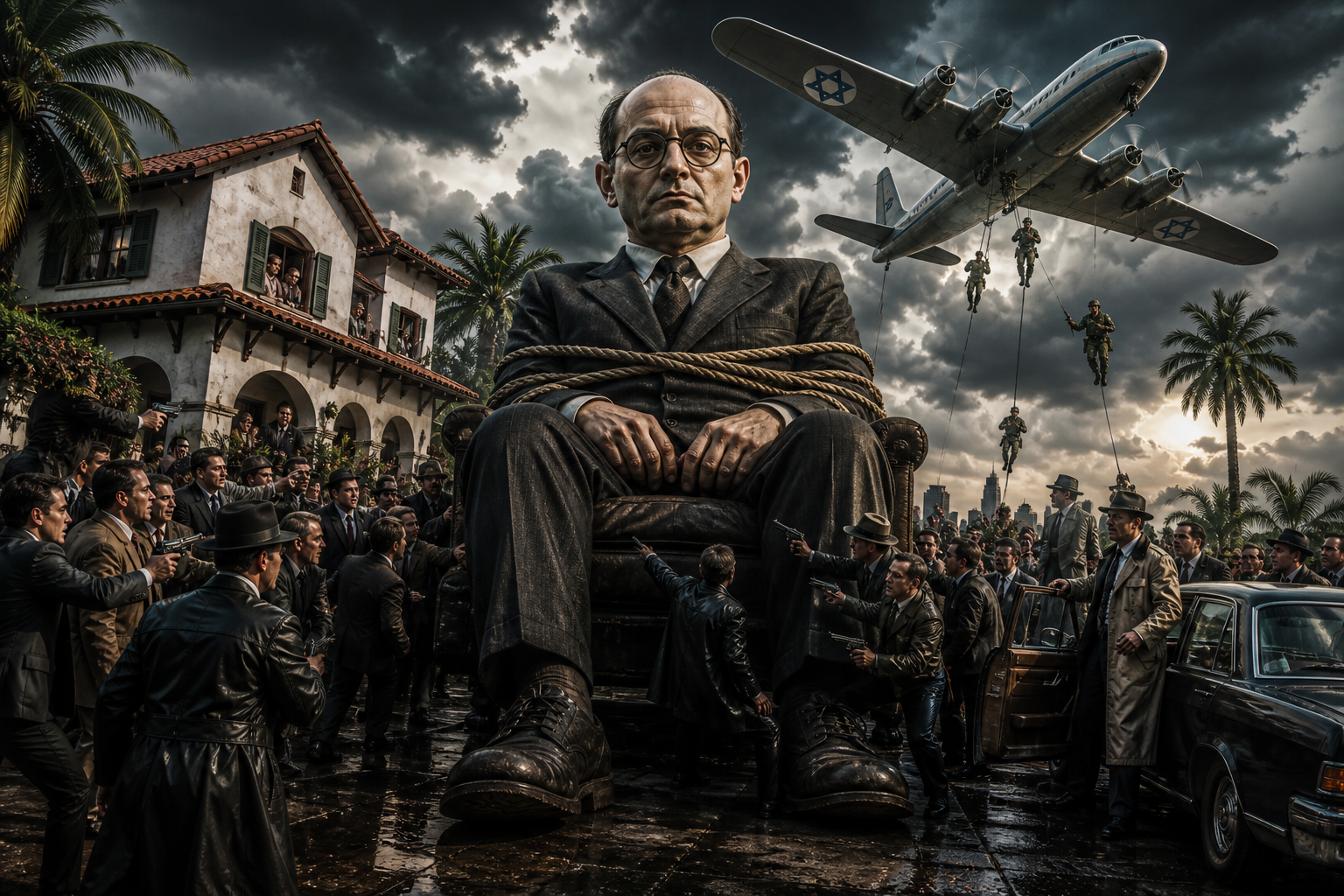
They snatched a monster from a bus stop, and no one heard him scream.
On the night of May 11, 1960, a man who called himself Ricardo Klement stepped off the number 203 bus in the working-class neighborhood of San Fernando, north of Buenos Aires. He was a factory worker at Mercedes-Benz. He was a husband. He was a father. He was also Adolf Eichmann, the cold-blooded bureaucrat who engineered the murder of millions of Jews in the gas chambers of Europe.
Within seconds, he was on the ground. Within days, he was in a foreign country awaiting trial. And Argentina, the country that had welcomed him with open arms and a fake passport, never even got a phone call.
🕵️ The Man Who Hid Behind a Lie
Let's be honest about how Eichmann got to Argentina, because the official history likes to pretend he just wandered there like a lost tourist.
He did not wander. He was smuggled.
After the war, Eichmann slithered out of Europe through what became known as the ratlines, the escape routes greased by sympathizers, forged papers, and yes, silence from powerful institutions that should have hunted him down. He arrived in Argentina in 1950 with a Red Cross travel document under a false name. He was one of thousands of Nazis who found warm beds and cold cover in South America.
Argentina under Juan Perón became a safe house for the architects of genocide. This was not an accident. It was a policy dressed up in diplomatic manners.
Think about that. The man who signed off on the deportation of human beings to their deaths was clocking in and out of an auto factory, riding the bus home, eating dinner with his family. A normal, boring, ordinary evil.
The Hunt Nobody Wanted
Here is the part they never teach you. Nobody was really looking for him.
The great empires had moved on. The Cold War was the new obsession, and old Nazis suddenly looked less like criminals and more like potential assets against the Soviets. The paperwork on the Holocaust was gathering dust. The world had decided that forgetting was easier than justice.
But a blind German prosecutor named Fritz Bauer refused to forget. And a survivor's family in Argentina, whose daughter had unknowingly started dating Eichmann's son, noticed something rotten. The boy bragged about his father. He spat out the same poison his father had lived by.
The tip made its way, quietly, dangerously, to Israel.
🇮🇱 Operation Finale: The Spies Move In
The Mossad, Israel's intelligence service, sent a team of agents to Argentina. Many of them had lost entire families in the camps. This was not a cold, professional job. This was personal in the deepest way a thing can be personal.
They watched the house. They confirmed the face. They memorized the bus schedule of the number 203.
The plan was simple and terrifying: grab him alive, hide him, and fly him out of the country under the noses of Argentine authorities who would absolutely have refused to hand him over.
On that May night, agent Peter Malkin approached him in the dark. The famous line, spoken in German, was almost gentle.
"One moment, sir."
Then the whole world grabbed Adolf Eichmann and pulled him into a waiting car.
Hidden in a Safe House, Smuggled in a Suit
They held him in a rented house for nine days. They fed him. They shaved him. They confirmed his identity down to the scars and the SS tattoo mark under his arm. He confessed who he was almost immediately, this man who had bragged for years about his loyalty to the machine of death.
Getting him out was its own miracle of nerve. An Israeli airliner had flown in carrying an official delegation as cover. When the plane was ready to leave, the agents dressed Eichmann in an airline crew uniform, drugged him lightly so he appeared to be a sick employee, and walked him right through the airport.
He flew to Jerusalem as freight. The most wanted ghost of the twentieth century, carried out in plain sight.
⚖️ The Trial That Made a Nation Remember
Argentina exploded with fury when it found out. It screamed about violated sovereignty, filed complaints at the United Nations, and demanded answers. The complaints had a point about international law. But the deeper truth was uglier: Argentina was embarrassed that its dirty secret had been dragged into the sunlight.
In Jerusalem, Eichmann sat in a bulletproof glass booth while survivors testified, one after another, telling the world what he had done. He offered the oldest excuse in the book.
"I was only following orders."
The philosopher Hannah Arendt sat in that courtroom and gave the world a phrase that still burns: the banality of evil. Eichmann was not a snarling cartoon villain. He was a paper-pusher, a careerist, a man who murdered by memo. That was what made him so horrifying.
He was found guilty. He was hanged in 1962. His ashes were scattered at sea, outside any nation's waters, so that no ground on Earth would hold him and no shrine would ever be built.
The Silence That Still Stinks
The capture of Eichmann was not the end of the story. It was a single crack in a wall of protection that shielded countless war criminals who died old and comfortable in their South American villas, sipping wine while their victims rotted in mass graves.
The question that should keep people awake is not how one man was caught. It is how so many others never were. Who signed the passports? Who looked away at the ports? Who decided that a genocidal accountant deserved a quiet retirement in the sun?
Eichmann rode the bus home for the last time on that autumn night. The gas chambers he organized had no bus stops, no return tickets, no shaving cream or last meals. He got a trial. His millions of victims got nothing but silence, and a world that took fifteen years to send anyone to knock on his door.