Brazil's Sugarcane Cutters Hold the Secret to Healing
In the sugarcane fields of northeast Brazil, aging cutters move like men half their age. Their bodies hold a truth the longevity industry sells back to the rest of us at a premium, and the history behind it smells like blood under perfume.
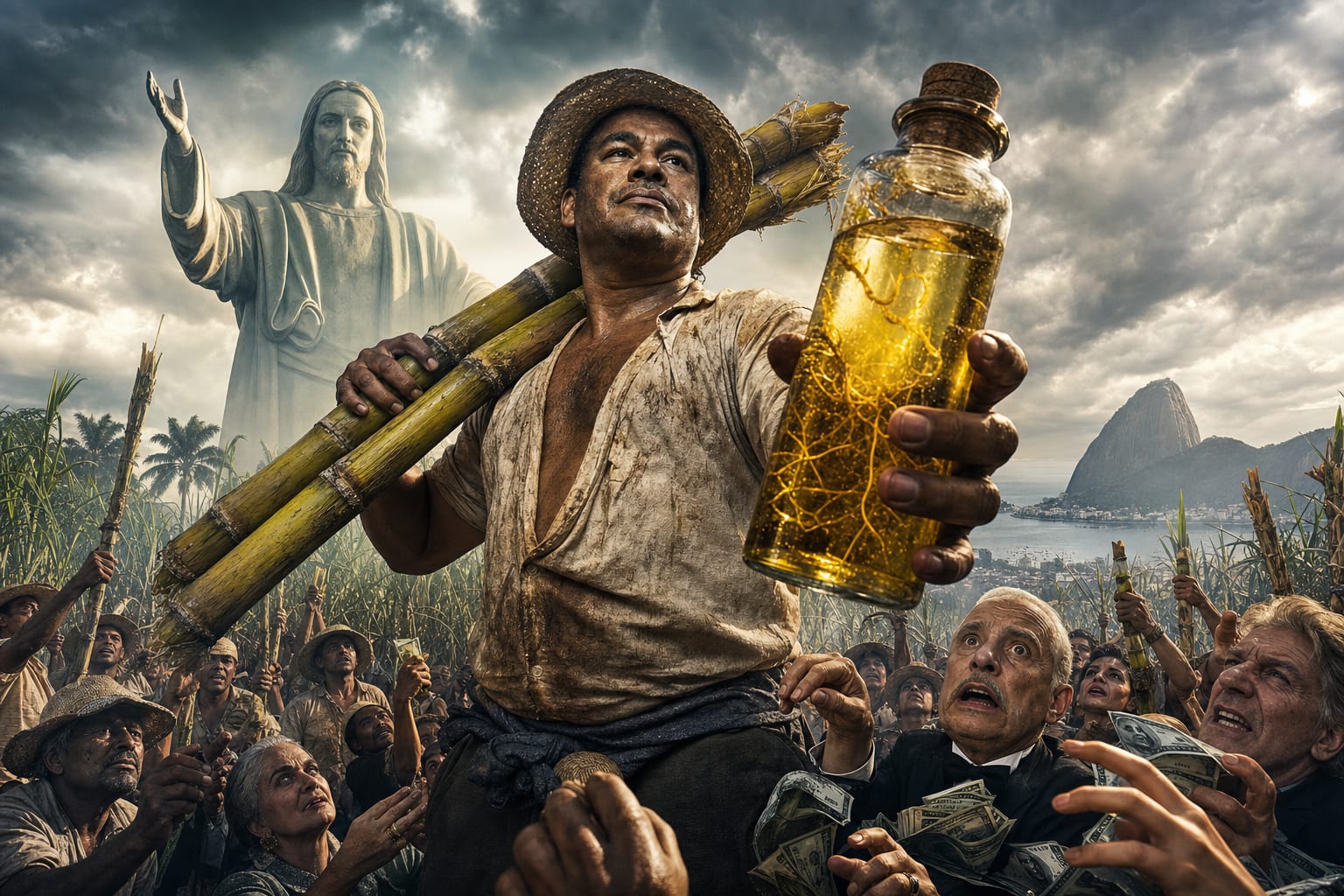
The men who cut sugarcane in the sertão of northeast Brazil should be dead a hundred times over, and instead they move through the fields like saints who forgot to die. Their bodies know something the clinics in São Paulo and Miami charge a fortune to hide from you. That is the position, and it will not soften as this goes on.
Come to Pernambuco at dawn. The heat is already a living thing, pressing wet fingers against your neck. The cane rises taller than a man, green blades that whisper and cut. A worker they call Seu Raimundo has swung his machete since he was nine years old. His hands are maps of every harvest. His spine has never seen an MRI.
He does not know the phrase chronic inflammation. He simply eats what the land gives, sweats out what the sun demands, and keeps moving. He is sixty-one and moves like a man of forty. Somewhere a wellness executive is selling that exact metabolism back to you in a monthly subscription.
The Ghost of the Casa Grande Still Signs the Checks
To understand these bodies you have to smell the old sugar money, and it smells like blood under the perfume.
The great houses of the northeast, the casas grandes, were built on the backs of enslaved Africans and starving migrants who fled the drought carrying nothing but the bones of their dead. The masters lived in white colonnaded elegance while the fields swallowed men whole.
The system never left. It only changed uniforms. Today the cane still feeds an empire, and the cutter still earns barely enough to keep his children in shoes. The old plantation logic decided long ago that some bodies exist to be spent and others to be saved.
That logic built the modern health machine too. It gatekeeps what should be simple. It waits for you to break, then bills you for the pieces. It calls aging a disease with a lifetime prescription attached.
Seu Raimundo has never paid it a cent. His grandmother treated fevers with boldo leaves and prayer to Nossa Senhora, a candle burning beside a photograph of a son the drought took. Superstition, the doctors would sneer. Yet the man is stronger than their patients.
What the Poor Know That the Powerful Paid to Forget
There is a cruelty so ordinary it becomes invisible here.
The cutter is paid by weight, so he bends ten thousand times a day, and his body adapts into something lean and impossible. Meanwhile the heir to the sugar fortune sits in an air conditioned tower, soft as a communion wafer, popping pills for a back that has never lifted anything heavier than a fountain pen.
Who is the wealthy one. Ask the machete.
The northeast holds secrets the glossy longevity clinics would kill to patent. The way the workers rest in the hottest hours, the deep afternoon stillness the colonizers mistook for laziness and the body knows as survival. The way movement is woven into every waking hour instead of purchased in a mirrored gym.
The way food arrives without a barcode. Cassava, beans, dendê oil the color of a sunset, fish pulled from the São Francisco river that the developers are slowly strangling. Nothing optimized. Everything alive.
You have been sold the lie that youth comes in a vial and healing comes with a copay. These men never got the memo. They are too busy being alive.
Beauty Beside the Collapse
By evening the fields turn the color of old gold. Somebody plays an accordion. A woman sells cocada from a bucket balanced on her head, and the sugar melts on your tongue like a small forgiveness.
The same cane that enslaved a people still sweetens the coffee of the men who cut it. The contradiction sits there, unbothered, the way everything absurd here is simply accepted as another Tuesday.
The workers laugh more than the tourists. They dance at funerals. They believe the dead walk among the rows at night, and honestly, who is to argue after a hundred years of unmarked graves feeding the roots.
Their vitality was never a mystery. It was a theft in reverse. They kept the ancient inheritance the rest of us traded away for convenience and a comfortable chair.
So the next time a man in a white coat tells you to accept the slow decay, to take the pill and sit down and wait for the end, remember Seu Raimundo at sixty-one, machete flashing in the sertão light, sweat and music and ghosts all around him.
He is not waiting for permission to be alive. And neither should you.