China Fires Submarine-Launched Ballistic Missile Into Pacific
China launched a submarine-launched ballistic missile into the Pacific after Australia and Fiji sealed a defense pact, a dangerous escalation rooted in decades of great power meddling that has always left working people to suffer.
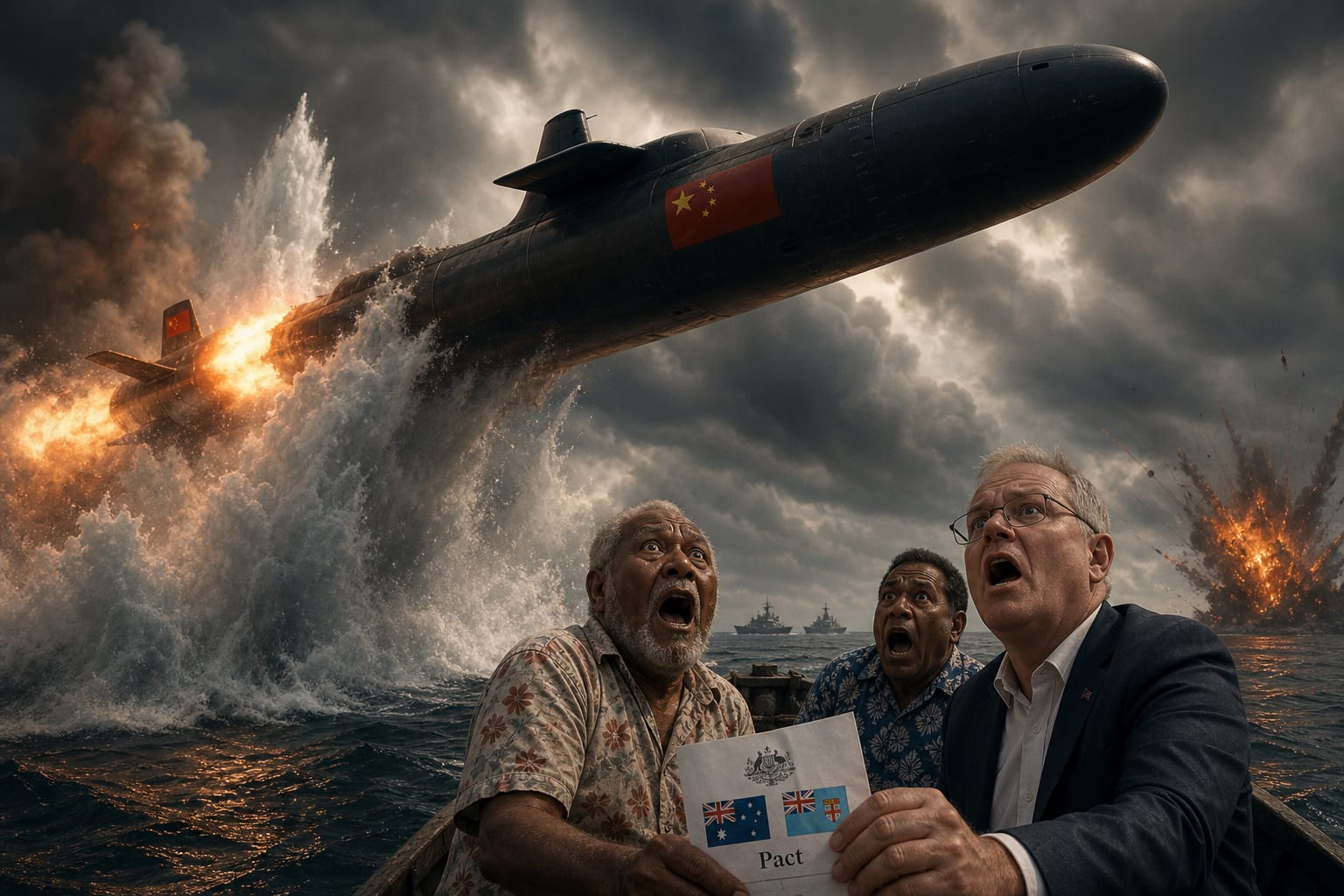
China’s submarine-launched ballistic missile test in the Pacific on Monday was reckless, yes, but it is not an isolated act of bravado. It is the predictable response of a rising power pushed into a corner by a Western-led campaign of encirclement and military deals across the Pacific. Make no mistake, the flash and splash are symptoms of decades of great power bullying that have turned the sea into a testing ground for weapons while ordinary people drown in insecurity and poverty.
This Test Did Not Appear Out Of Thin Air
China’s state media said the missile, launched from a nuclear-powered submarine at 12:01 p.m. Beijing time, carried a mock warhead and landed in a designated area. The test was the first of its kind in two years. Governments across the region had been warned beforehand, yet the announcement came immediately after Canberra and Suva unveiled a mutual defense treaty and a new regional security compact. That timing is not coincidence. Canberra has been striking defense deals with Pacific island nations in a push widely understood as a counterweight to Beijing. The result is a tinderbox.
Last year’s alarm was similar. In September 2024 China publicly announced an intercontinental ballistic missile test that flew across the Pacific into waters near French Polynesia. Those launches forced Pacific capitals to reckon with a reality many of their people already live: the ocean that sustains them has become an arena for rival powers to prove that they can push buttons and project force.
The Poor Have Always Paid For Great Power Games
If you live in a Pacific atoll, a Fijian village or a Latin American coastal town, the smells and sounds of geopolitics are not abstractions. They are the hum of ships that out-fish local boats, the gates closed by foreign contractors, the sudden decline of tuna catches when fleets arrive. People remember not only the explosions but the aftermath, the empty nets and the children who go hungry while diplomats trade security guarantees over cocktails.
These tensions echo a brutal history. In Latin America the pattern is clear. For generations U.S. interventions and corporate interests carved up lands, crushed unions and propped up regimes that protected profit over lives. Guatemala still remembers how foreign fruit companies and their Washington backers rewrote its destiny in 1954. Chile’s streets still carry the silence of 1973, when a democratically elected government was toppled with outside assistance that put corporate and geopolitical interests above human life. Nicaragua, Central America and the Caribbean still count the cost of decades when external power politics turned neighborhoods into graveyards and economies into extraction zones.
Those are not distant lectures. They are the origin stories of millions who woke to planes overhead and men in uniforms taking their fathers away, the small hands of children that reached for bread that was no longer there, the mothers who learned to hide their grief because there was no room for it in the news bulletins that praised stability. Those scars shape how nations respond when their seas become battlefields.
Australia, Washington And The Hypocrisy Of 'Security'
Australia’s outreach to Pacific states is being sold as security reassurance. In practice it looks like a return to spheres of influence under new branding, a militarized diplomacy that invites countermeasures. When Canberra signs defense pacts with island capitals, Beijing will answer in the only currency it trusts. The test on Monday was billed as not directed at any country, but the choreography of announcements and the geography do not lie.
Look to the lived memory in the region. In French Polynesia the clean blue of lagoon water carries the memory of nuclear tests at Moruroa, where generations remember hearing echoes of a different kind of power play, and the reef communities still debate the long term health consequences. In the Pacific Northwest and the ports of Latin America dockworkers recall how foreign fleets and foreign policy have always set the terms of their labor. These are little-known threads that tie the present to a past of extraction and violence.
Those who cheer on new security pacts without asking who pays the price should walk the empty piers at dawn in a tropical port and watch a child count the boats that did not bring fish. The child will tell you what every treaty does not—security is not distributed equally, and the poor carry the bullets and the long, slow hunger that follows geopolitical games.
China’s missile splash should shock the world. What should be more shocking is how easily the West will return to the same script that produced this ripple: treaties signed in capital cities, fleets deployed, and ordinary people left to shoulder fear and dwindling livelihoods. If governments want peace, they must stop treating the Pacific as a chessboard and start listening to the people who live beside these waters. Until then the flashes will continue and the human cost will deepen.