Earthquake, Priests and Blood: How the 1812 Caracas Quake Shattered Venezuela’s First Republic
A powerful earthquake in March 1812 shattered Caracas, killed and burned hundreds, and gave conservative clergy and royalist commanders the opening they needed to crush Venezuela’s fragile First Republic. The quake reshaped the war for independence and left wounds that lasted through Bolívar’s long fight to 1824.
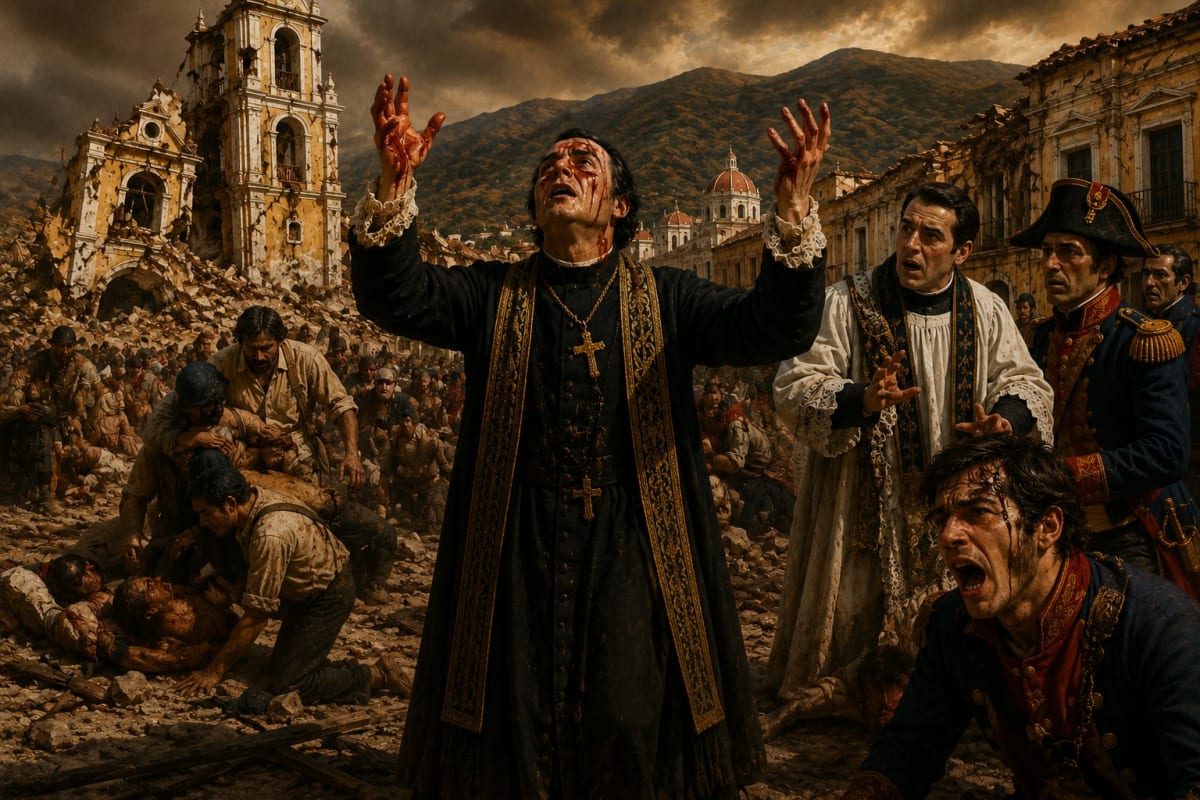
The Shock That Broke a City
On March 26, 1812, a massive earthquake rocked Caracas and spread its waves as far as Bogotá. The shock buried storehouses, broke waterpipes, and left the city without safe drinking water. Nine out of ten prosperous caraqueño houses fell. Congress held its last session on April 6, 1812.
Rescuers dug survivors from the rubble with their hands. Bodies were burned in bulk on the beach at La Guaira. Witnesses said about forty were thrown into each fire so sailors could see the flames at sea. Alexander von Humboldt wrote, “The City has disappeared.”
Religion, Royalism and a Political Earthquake
The quake was physical. It was also political. Archbishop Coll y Prat, born in Cataluña, told priests to preach that the earthquake was God’s chastisement. He pointed to the cathedral that still stood and said God had spared the faithful.
The archbishop’s sermons helped fuel a conservative comeback. Royalists who had fled returned with servants and loud shows of penance. Processions in sackcloth filled the streets. People who did not show penance were called sinners.
Domingo de Monteverde, a loyal but poorly armed frigate captain, led the royalist pacification from the sea. By June, U.S. consul Robert Lowry told Secretary of State James Monroe that royalist forces had penetrated deep into the interior. He blamed priests for stirring “superstitious” recruits.
Revolutionaries, Emancipation and a Fracture
The republicans tried to fight back. The Sociedad Patriótica named Francisco de Miranda dictator. Miranda arrested Spaniards and Canary Islanders and promised freedom to any slave who took up arms for Venezuela.
That decree angered white elites and the clergy. The archbishop secretly urged enslaved and free Blacks to defend the king. Rumors of the archbishop’s capture sent a column of armed people of color marching toward Caracas. By late June a battalion was about 12 leagues from the city gates.
Miranda opened talks with Monteverde. On July 25, 1812, Miranda surrendered and soon was sent to Spain. He died in a Spanish prison on July 14, 1816, the same day France once celebrated the Bastille.
Simón Bolívar, then 29, watched this unfold. His house near Plaza San Jacinto survived with buckled beams. Witnesses saw him hauling survivors from ruins and arguing with those who said the quake proved the sin of independence.
War, Atrocity and the Human Cost
The counterrevolution did not stop with Monteverde. José Tomás Boves rose in the eastern llanos after being freed from prison. His irregular army grew to about 7,000 men. Many were former slaves, cowherds and peasants who answered his black flag and skull and crossbones banner reading “Liberty or Death.”
Boves fought a merciless war of class and race. In Ocumare in February 1814 his men raped, mutilated and murdered. Survivors hid in churches. Boves’s soldiers slaughtered people inside those churches.
In response, Bolívar ordered mass executions. Historians estimate as many as 1,000 Spanish prisoners were shot or hacked to death in mid-February 1814. Mass graves, mutilations and public pyres followed. The roads and fields filled with unburied corpses.
On June 15, 1813, Bolívar had declared a “war to the death.” By July 6, 1814, with Boves closing in, he ordered Caracas evacuated. Twenty thousand residents fled. Many died on the roads of hunger, dysentery and snakebite. Churches were stripped of silver to pay soldiers. The Second Republic had ended.
Aftermath and Why It Still Matters
Boves was killed in 1814. Spain sent a large expeditionary force of about 10,000 men under Field Marshal Pablo Morillo. The countryside was a patchwork of refugee camps, bandits and shifting loyalties.
Bolívar did not give up. He regrouped in Cartagena and later accepted aid from Haiti. The Haitian government sent 1,000 rifles, gunpowder, clothing and advisers. Bolívar issued emancipation on horseback, freeing slaves who joined the fight.
By August 1824, Bolívar’s army of roughly 8,000 routed Spanish troops in the highland plains at Junín. Spain’s hold on South America collapsed. But the price was huge. Cities burned. Families scattered. The republicans learned that disasters can be turned into political weapons.
A Hard Lesson and a Sharp Comparison
Nature did the shaking. Men did the shaking down.
The earthquake showed how fragile a revolution can be when fear meets faith. When priests preached a divine verdict, elites used the scare to roll back liberty. When a promise of emancipation frightened property owners, old loyalties flipped. Armies grew from the very people both sides feared and needed.
If you want a comparison Americans might not expect, think of how natural disasters in Latin America can become political machines. The La Guaira pyres and sackcloth processions echo later moments when a hurricane or quake became the pretext for old powers to return. The old city courtyards, the Andalusian casas, the public burnings on a Caribbean beach visible to ships: these are details a Latin mind remembers, and they teach a cold lesson. Catastrophe is a tool. People are the cost.
That is why the 1812 quake matters today. It did not just break buildings. It broke trust. It pushed leaders to hard choices. It showed how emancipation could be promised and weaponized. It left scars on Venezuelan politics that helped shape Bolívar’s demand for a strong executive and his uneasy belief that only force could hold a fracturing land together.
History kept moving. But the pyres at La Guaira and the massacres in Ocumare remain. They are reminders that revolution and disaster can feed each other. That is the bitter and darkly comic truth. The earth fell out from under Caracas. Men then fell on one another.