General Manuel Noriega: The Pockmarked Dictator Who Voodoo-Cursed His Enemies and Kept Freud in a Frozen Buddha
Manuel Noriega ran Panama with cocaine cash and a personal witch, froze his enemies' photos in a Buddha-shaped freezer, and surrendered not to soldiers but to a boombox blasting rock music outside a holy embassy.
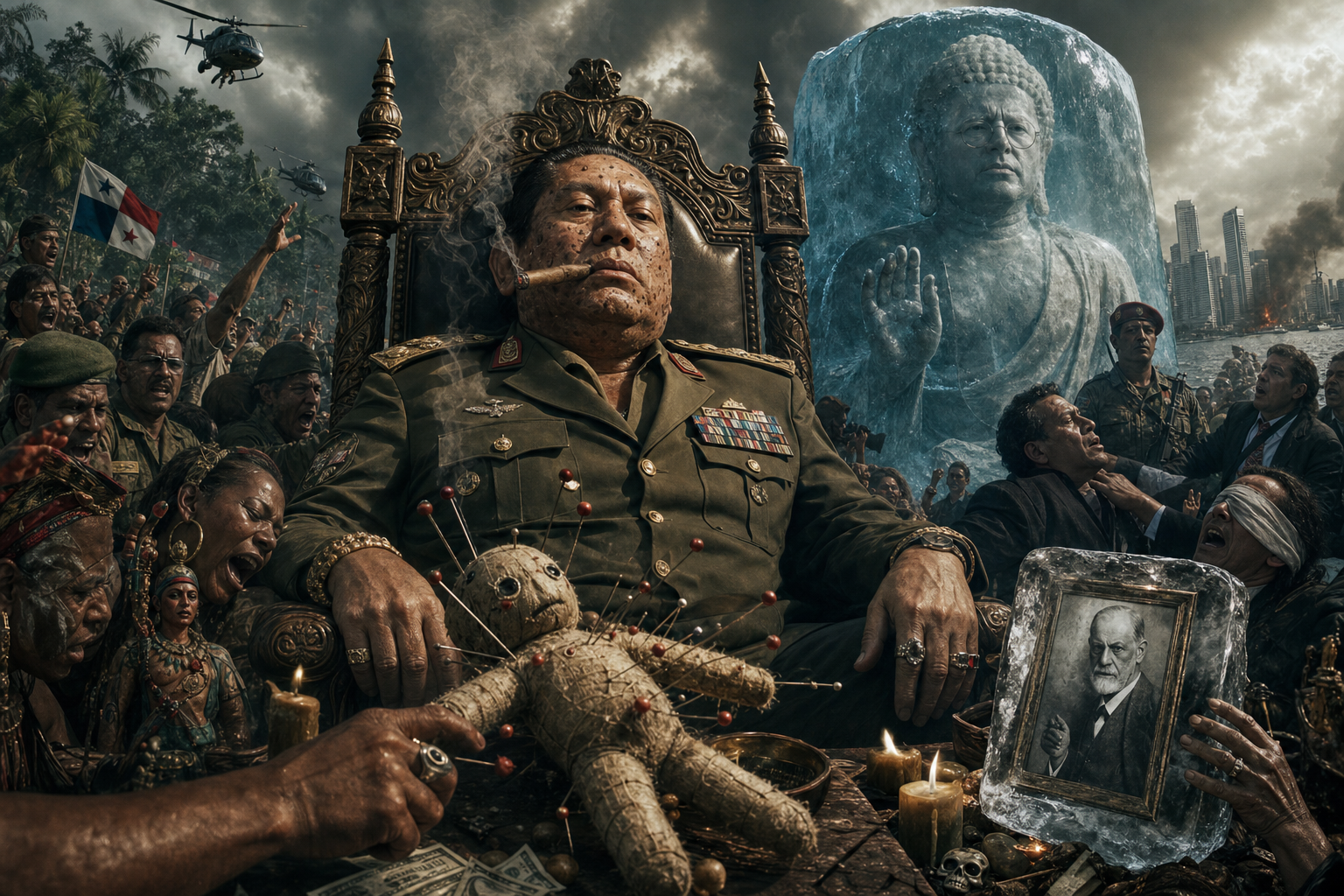
The most powerful man in Panama once wore red underwear to repel the evil eye and nobody laughed, because the men who laughed had a way of vanishing into ditches.
Manuel Antonio Noriega was not a handsome man, and this mattered to him more than the constitution he shredded. His face, ravaged by acne so severe that soldiers whispered nicknames behind their rifles, became the central tragedy of his psychology. They called him Cara de Piña, Pineapple Face, and no amount of stolen millions could sand it smooth.
Here was a man who ran a country the size of a dinner napkin and believed himself a colossus.
The Superstition Palace of a Frightened Strongman
Strip away the epaulets and the cocaine cash and you find a deeply frightened little man arranging candles.
Noriega was obsessed with the occult. Not casually, not as a hobby for rainy afternoons, but as a governing philosophy. When American soldiers finally stormed his hideouts in 1989, they did not find war rooms and battle maps waiting for them.
They found buckets of blood, effigies wrapped in tinfoil, and photographs of his enemies stuffed inside a freezer, frozen solid so their spirits could not fight back.
Imagine the vanity. A general who commanded thousands genuinely believed that Ronald Reagan could be defeated by a Polaroid on ice.
He surrounded himself with red objects, kept a personal witch on the payroll, and painted the walls of certain rooms specific colors to ward off spiritual attack. The Pentagon expected a mastermind. Instead they got a man who fought geopolitics with tinfoil and imported Brazilian sorcery.
From CIA Paycheck to Public Enemy
The delicious irony is that Washington built this man and then acted shocked when he behaved like a monster.
For years Noriega collected a fat salary from the CIA. He was their guy, their listening post, their useful thug in a strategic corner of the world. The Americans knew about the drugs. They knew about the money laundering. They knew about the disappearances.
They paid him anyway.
He was a double agent, triple agent, quadruple agent, selling information to anyone with a checkbook while cashing checks from all of them at once. He played the superpower like a marionette and believed he was too clever to ever pay the bill.
The bill arrived in December 1989 with twenty-seven thousand American troops attached.
The Blessed Trinity of Dictator Vanity
Every tin-pot tyrant collects the same three trophies, and Noriega checked each box with pathetic enthusiasm.
- The Wardrobe: Piles of pressed uniforms, medals he awarded himself, and enough decorations to sink a small boat.
- The Cash: Suitcases and bank accounts stuffed with drug money, the true currency of his imaginary empire.
- The Magic: The voodoo, the potions, the frozen enemies, the desperate belief that the universe owed him protection.
A grown man with an army and a treasury, and his final line of defense was a hex.
Cornered Like a Rat in a Holy House
The great warlord did not go down shooting. He went down hiding.
When the invasion crushed his forces, Noriega scampered into the Vatican embassy and begged for sanctuary. The unbeatable general, the man who cursed presidents with frozen photographs, was reduced to a trembling guest in a religious building.
So the American soldiers did something magnificent in its cruelty.
They surrounded the embassy and blasted rock music at deafening volume, day and night, until the man who feared evil spirits could no longer bear the sound of Guns N' Roses.
He surrendered on January 3, 1990. Not to bullets. To a boombox.
The Long, Slow Deflation
The rest is a story of shrinkage, the steady deflation of a pineapple left too long in the sun.
Miami convicted him on drug charges. France convicted him on money laundering. Panama convicted him for the murders of people he made disappear. He bounced between prison cells on three continents like unwanted luggage, each country happy to hold him and none eager to keep him.
He spent his final years in a Panamanian cell, an old man with a ruined face and a ruined legend, still furious that history refused to crown him.
The witch could not save him. The red underwear could not save him. The frozen enemies thawed and outlived him.
He died in 2017, and the pineapple finally rotted where it fell.