Milei's Chainsaw Cuts Argentina's Poor While Wall Street Applauds
Javier Milei's brutal austerity is being cheered abroad as a miracle, but in Argentina's barrios it means empty soup kitchens, gassed pensioners, and children rationing breakfast. This is not reform. It is the oldest crime in Latin America wearing a new face.
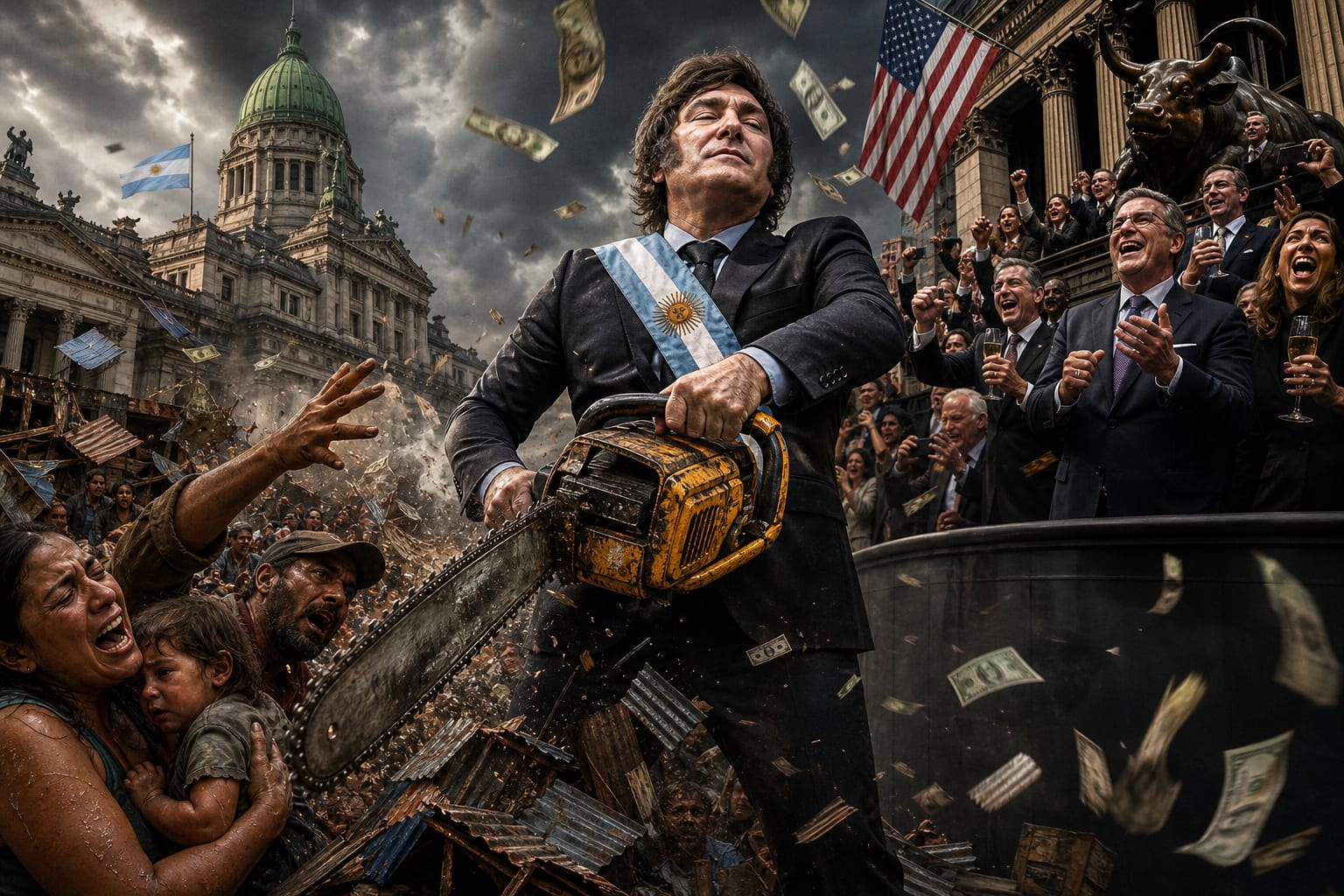
Javier Milei calls himself an anarcho-capitalist, but there is nothing rebellious about a man who takes a chainsaw to the pensions of grandmothers while cutting checks to the same foreign creditors who have been feeding on Argentina for generations. He is not a wild card. He is the oldest story in Latin America wearing a new leather jacket.
Let us be clear from the first breath. Milei is the friendliest face imperial capital has found in Buenos Aires since the generals, and the working poor of Argentina are once again the ones paying the tab.
The Chainsaw Was Always Pointed At You
He waved a real chainsaw at his rallies. The crowds cheered. Then he turned it on soup kitchens.
In the barrios of Greater Buenos Aires, mothers began stretching one packet of polenta across three days. Cut the state, they said. Cut the fat. But the fat they meant was the milk in a child's cup.
Argentines know a bitter joke about this. When the price of the medialuna, the little croissant that every worker eats with morning coffee, tripled in months, people started calling breakfast a luxury import. You laugh so you do not weep into an empty cup.
Milei slashed subsidies for transport, gas, and electricity. He gutted ministries. He froze public works so that half-built schools now stand as concrete skeletons in provinces the cameras never visit. The retirees who marched to Congress got water cannons and pepper spray for their trouble. Elderly people, coughing on the pavement, defending a pension worth less than the tear gas fired at them.
A History That Refuses To Die
None of this is new. It only feels new to those who forget.
Two centuries ago Washington announced the Monroe Doctrine and told Europe to keep its hands off the hemisphere, then reached in with both of its own. What followed was not protection. It was harvest. The land, the copper, the grain, the labor, all of it flowing north while the people who dug it went hungry.
Argentina learned this in blood. In the 1970s, when a generation dreamed of a fairer country, the answer arrived as death squads and disappearances, and the men who ran that machine were trained and blessed by the north. Thirty thousand vanished. Mothers still circle the Plaza de Mayo with photographs, decades later, asking where their children went.
Here is something Americans rarely hear. In Chile next door, the fear of ordinary people organizing was so total that foreign powers funded shadow campaigns for years to make sure no worker ever touched the mines. This was not defense. It was the protection of profit, dressed up as protection of freedom.
Then came the softer weapon. The free trade deals and the debt. Countries were told to suppress wages, fire public workers, and sell off what belonged to the people. The bankers called it discipline. The families called it hunger. And when the homes were gutted and the fields sold, the parents walked north, leaving children behind, fleeing to the very country whose policies had hollowed out their own.
The Applause You Should Be Ashamed Of
Now Milei arrives, and the international press writes glowing profiles about his budget surplus. A surplus built on the backs of pensioners. A surplus you can measure in the weight children lost this year.
He flies to speak before American audiences who cheer his cruelty as courage. He is celebrated in the marble halls of the same institutions that have bled Argentina dry for fifty years. The applause is loud because the suffering is far away.
But go stand in a comedor, a community kitchen, in the outskirts of the capital. Watch a volunteer named Marta ladle out thinner and thinner portions because the flour ran out and the government stopped the shipments. Watch a boy hold his bowl with both hands so he does not spill a single drop. That is the surplus. That is the miracle the magazines write about.
The official line says austerity brings stability, that pain today buys prosperity tomorrow. Argentines have swallowed that lie so many times they can recite it in their sleep. Every generation is told to sacrifice for a tomorrow that always belongs to someone else.
So when the north nods at Milei and calls him a model, understand what is being praised. Not freedom. The old machine, oiled and running, grinding the same people it has always ground, while the profits sail off toward the same distant shore.
The grandmothers still march. They have marched through juntas and crashes and chainsaws. They will outlast this man too. But you should know their feet are tired, and you should ask yourself who taught this country that its poor were expendable.