Pablo Escobar's Medellin: The Bloody Empire That Still Haunts Colombia Today
Pablo Escobar built a drug empire that moved 80 percent of America's cocaine and left thousands dead. Decades after his 1993 death, his violence, his myth, and even his wild hippos still shape Medellin today.
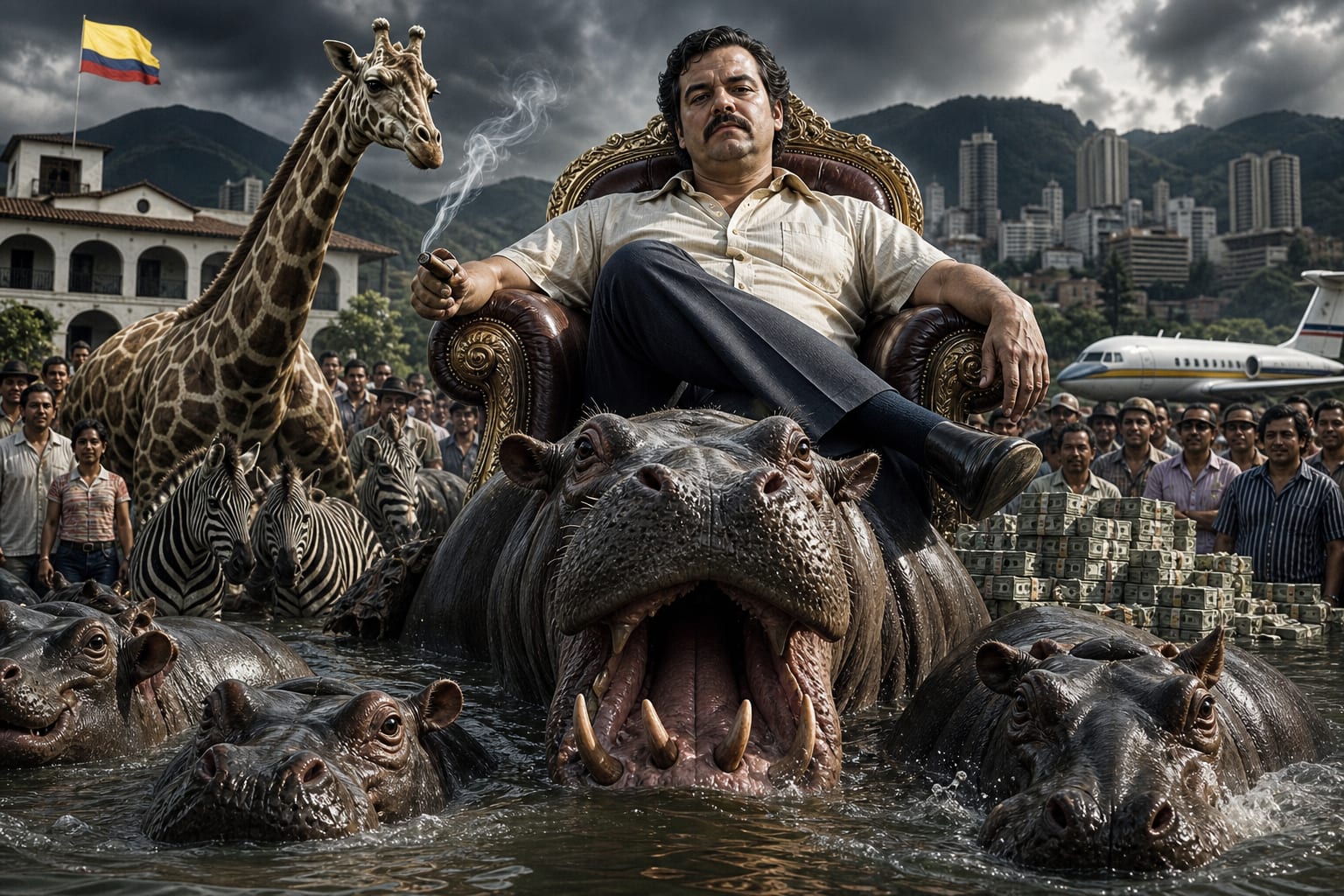
The man built a zoo in the middle of a country that could barely feed itself. That tells you almost everything about Pablo Escobar.
He filled a giant ranch called Hacienda Napoles with hippos, elephants, giraffes, and zebras. He flew them in from Africa. When the government finally seized the ranch, the hippos stayed. They swam into the rivers. Today there are dozens of wild hippos loose in Colombia. Scientists now call them an invasive species. Escobar is dead, but his hippos keep having babies.
This is the strange truth about the most famous drug lord in history. Even his pets refused to die.
The Poor Boy Who Became a King
Pablo Emilio Escobar Gaviria was born on Dec. 1, 1949, in Rionegro, Colombia. He grew up near Medellin, a city in the mountains. He was not born rich. He started small, stealing tombstones and smuggling.
Then he found cocaine.
By the 1980s he ran the Medellin Cartel. At the peak, his operation moved around 80 percent of the cocaine smuggled into the United States. The money was so big he could not count it. His organization spent thousands of dollars a month on rubber bands just to hold the cash together.
In 1989, Forbes magazine listed him as one of the richest men on Earth. His net worth was estimated near 30 billion dollars. He was a poor kid from the mountains who ended up on a rich list read by American bankers.
He had a nickname that showed both sides of him. Some called him El Patron, the boss. To the poor, he was something else.
Bullets or Silver
Escobar had a simple business rule. He called it plata o plomo. That means silver or lead. Take my money, or take my bullet.
Many chose the money. Judges, police, and politicians took his bribes. The ones who said no often died.
The violence was enormous. Escobar is blamed for the murders of thousands of people. He is linked to the killing of hundreds of police officers in Medellin alone. He ordered the assassination of a presidential candidate, Luis Carlos Galan, in 1989. Galan had promised to crush the cartels.
That same year, Escobar's men were tied to the bombing of Avianca Flight 203. The plane exploded in the sky. All 107 people on board were killed. The target was a presidential candidate who was not even on the flight.
Here is the part Americans often forget. The people who died were not gangsters. They were teachers, workers, mothers, and children waiting at bus stops. They were just Colombians who happened to be alive in the wrong decade.
Colombia in that time was one of the deadliest places on the planet. Medellin became famous around the world for the wrong reason.
The Prison He Built Himself
In 1991, Escobar made a deal with the Colombian government. He agreed to go to prison. But he built the prison himself.
It was called La Catedral. People called it Hotel Escobar. It had a soccer field, a bar, and a beautiful view of the mountains. He picked his own guards. He kept running his empire from inside.
When the government tried to move him to a real jail in 1992, he simply walked out.
That was too much, even for a country used to his tricks. A special unit called the Search Bloc hunted him. A shadowy group called Los Pepes, made up of his enemies and rivals, also went after him. The United States sent help too.
On Dec. 2, 1993, one day after his 44th birthday, they found him. He was on a rooftop in Medellin, running across the terracotta tiles in his socks. He was shot and killed there.
The photos of that rooftop went around the world.
Why He Still Matters
Escobar knew the poor loved a generous villain. He built houses for slum families. He built soccer fields. He gave money to churches. In some neighborhoods, people still leave flowers at his grave. To them he was a Robin Hood, even though his fortune was built on blood.
This is the detail outsiders miss. In parts of Medellin, he is remembered as a man who helped when the government did nothing. That love and that horror live in the same city, at the same time.
The official view was different. The Colombian government and the United States called him a terrorist and a mass murderer. They spent years and millions of dollars to destroy him. His war pushed Colombia to the edge.
His death did not end cocaine. The Medellin Cartel fell apart, but the Cali Cartel rose. The drug trade shifted, split, and survived. Cocaine still flows north today. The demand never stopped.
Now Medellin has changed. It is a tourist city with cable cars, good coffee, and famous nightlife. Travelers come from all over the world. Some of them come exactly because of the Escobar name, buying tours and T-shirts. Many locals hate this. They lost family members. They do not want their pain sold as a souvenir.
And in the rivers, the hippos still swim. Big, gray, and stubborn. They are the last members of an empire that refused to leave.
Escobar wanted to be remembered forever. He got his wish. Just not the way he planned.