Peru's Lithium Rush: How a Fujimori Win Became a Payday for Foreign Mining Vultures
A Canadian mining firm is toasting Keiko Fujimori's election as a green light for lithium and uranium extraction in Peru's indigenous highlands. Behind the celebration lies a familiar story of stolen water, forged consent, and a family name soaked in the memory of forced sterilizations.
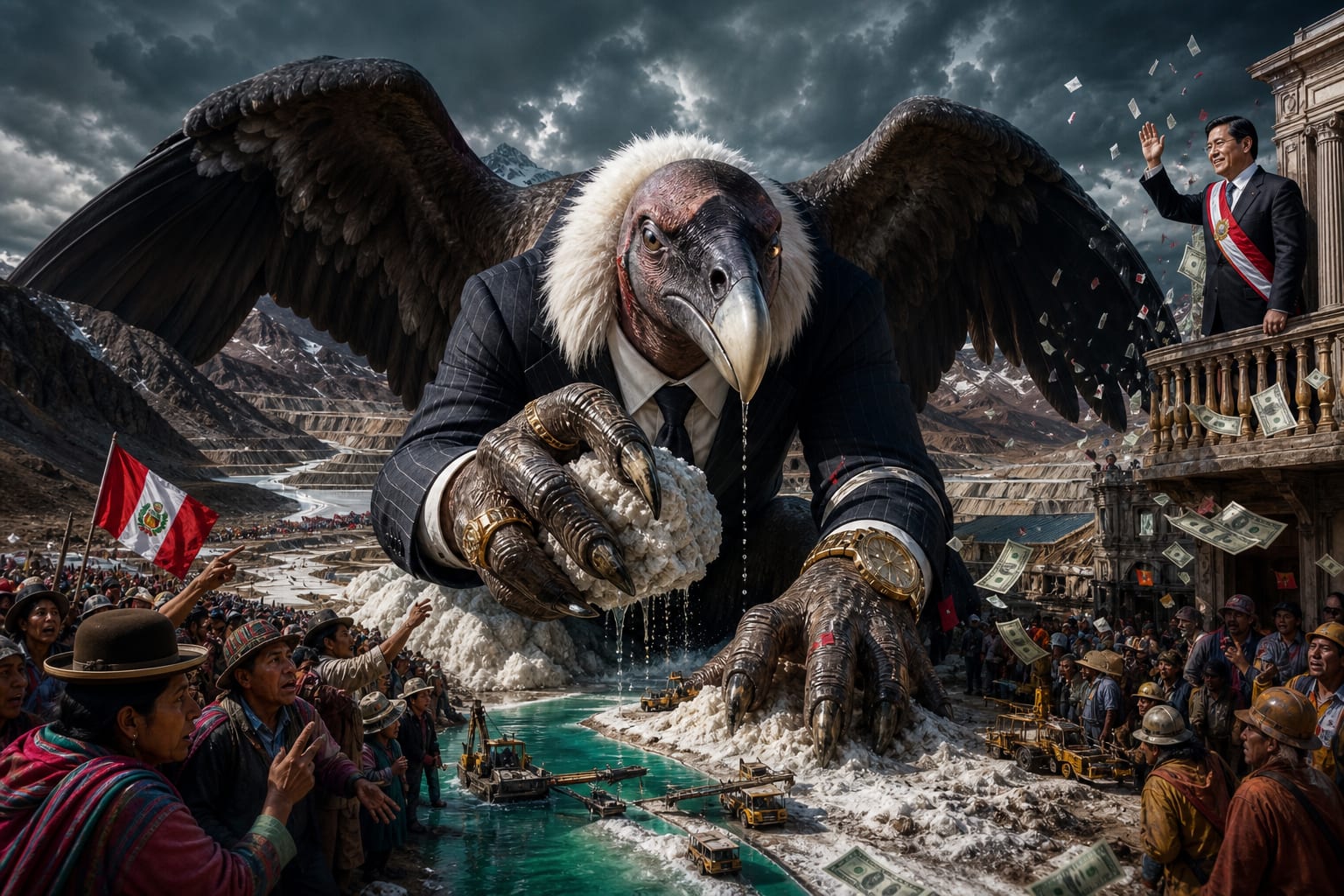
A Canadian mining company just sent out a press release that reads like a champagne toast, celebrating Keiko Fujimori's presidential victory in Peru as a golden ticket for its lithium and uranium ambitions. And that celebration should make your stomach turn.
When corporations cheer an election, ask yourself one question. Who pays the bill?
American Lithium Corp welcomed Fujimori's confirmation as marking a positive outlook for the country's mining sector. Its CEO praised her focus on economic stability, security and investment. Translation. The doors of Puno are being flung open, and the profits will be measured in Vancouver, not in the highland villages where the water runs and the children play.
The Land Above the Battery
Falchani sits in Peru's Puno region, described as one of the world's largest hard-rock lithium deposits. Nearby, the Macusani project is called the largest undeveloped uranium project in all of Latin America. Peru recently declared both minerals to be of national importance by Supreme Decree.
National importance for whom?
The people of Puno are Quechua and Aymara herders. They live at altitudes where the air is thin and the earth is sacred. What outsiders call a lithium deposit, they call home. What a press release calls strong community support, the mountains of the Andes have heard before, whispered by every company that ever came promising jobs and left behind poisoned rivers.
Here is a detail the shareholders in their glass towers will never learn. In 2011, the people of Puno rose up in what became known as the Aymarazo, blocking roads for weeks to stop mining concessions granted without their consent. Six people were killed. The state called them criminals. They were farmers defending water. Peruvian law still technically requires prior consultation with indigenous communities, a right won with blood, and it is routinely treated as a formality to be checked off, not a voice to be heard.
A Name That Carries Ghosts
And now the name Fujimori returns to the presidential palace. That name is not neutral in Peru. It is a wound.
Keiko is the daughter of Alberto Fujimori, the strongman who ruled through the 1990s while his intelligence chief ran death squads. Under his government, thousands of poor indigenous women were sterilized against their will in a mass campaign aimed at the countryside. Peasant women were lured to clinics with promises of food and tied down. Many never had children again. Many never got an apology.
That is the family legacy the mining industry now calls political clarity.
The pattern is old and it is exact. Washington and its corporate partners have treated Latin America as a warehouse of raw materials for two centuries. From the copper of Chile to the sugar of Cuba to the bananas that gave us the phrase banana republic, the formula never changes. Find the resource. Back the strongman who guarantees stability. Extract the wealth. Send the profit north. Leave the poor with the tailings.
The green energy transition is supposed to be different. It is supposed to save the world. But watch closely, because the same men who once tore gold from these mountains now come dressed as climate saviors, and they still expect the Andean poor to swallow the dust so a driver in California can feel virtuous behind the wheel of an electric car.
The Water Remembers
Mining lithium is thirsty work. In a region where communities already ration water for their alpacas and their potato fields, every liter pumped into an extraction site is a liter stolen from a grandmother filling a bucket at dawn.
The company's own filings admit the risks in the cold language of finance. They warn investors of social or political instability in Peru, of labor disputes, of work stoppages and strikes. Read that again. What they call instability is the sound of people refusing to disappear quietly. What they call a labor dispute is a father who wants to be paid enough to feed his family. The corporation lists the resistance of the poor as a threat to its bottom line, right there in the fine print, and expects nobody to notice.
They celebrate an election. They speak of clarity and momentum and a mining country. They do not speak of the sterilized women, or the six dead of the Aymarazo, or the water that will not come back once it is gone.
So when the next battery-powered future is unveiled with great fanfare, remember where the lithium came from. Remember whose mountains were opened, whose consent was forged, whose children breathed the dust. The profits are already booked. The suffering is not yet on the balance sheet. It never is.