Sea People With Built-In Scuba Tanks: How the Bajau Evolved Bigger Spleens
The Bajau of Southeast Asia live on houseboats and dive for shellfish eight hours a day. New research shows their spleens are about 50 percent larger, tied to a gene called PDE10A and a way of life shaped over 15,000 years.
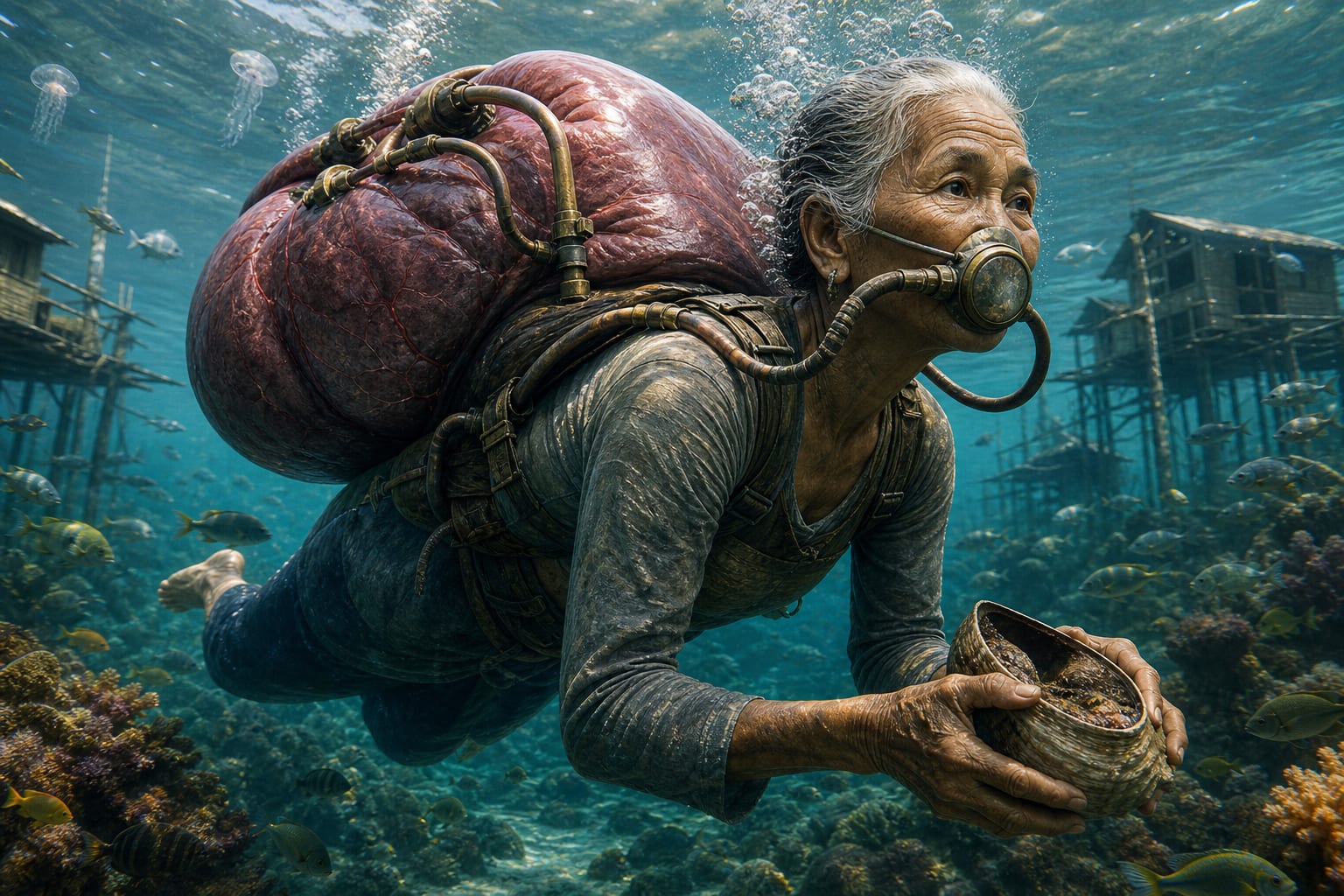
The Bajau are sea people who live across the southern Philippines, Indonesia and Malaysia. Rough estimates put their number at about 1 million. Scientists say their bodies carry a surprise that reads like a fable from an old shore village. Their spleens are larger. Much larger.
A Nation That Lives On The Water
For possibly thousands of years the Bajau have lived on houseboats and stilt houses. They travel from place to place and visit land only sometimes. The Venetian explorer Antonio Pigafetta wrote about them in 1521. They dive for shellfish with a wooden mask or goggles and a simple weight belt. They dive repeatedly for about eight hours a day. They spend roughly 60 percent of that time under water. Individual dives can be 30 seconds to several minutes. Some reach depths of over 70 meters.
Everything they need they get from the sea. That is a life that makes the body a tool and the tool a story. It is also a dangerous job. Hour after hour underwater means stress on the lungs, the heart and a thousand small risks. The sea takes as much as it gives.
The Spleen That Became A Tank
Researchers led by Melissa Ilardo of the University of Copenhagen used a portable ultrasound machine in Indonesian Bajau communities. They found that the Bajau have spleens about 50 percent larger on average than a neighboring farming group called the Saluan. The team published their results in the journal Cell.
The spleen sits close to the stomach. It removes old cells and stores oxygenated red blood cells. When a diver holds a breath and submerges, a human dive response slows the heart and sends blood to the vital organs. The spleen contracts and releases red blood cells. The effect is like a biological scuba tank. For the Bajau, that tank is bigger.
Ilardo also measured people who do not dive within the Bajau community. Their spleens were similar to those of divers. That helped show that the enlargement was not only practice. The size difference appeared to be built in.
Genes, Time And A Question
Co-author Rasmus Nielsen of the University of California, Berkeley carried out a selection scan of genomes from the Bajau, the Saluan and Han Chinese. He and colleagues found 25 sites in the genome that differ significantly in the Bajau. One site stood out. Variants in a gene called PDE10A correlated with larger spleen size even after accounting for age, sex and height.
In mice, PDE10A helps regulate a thyroid hormone that controls spleen size. That link in animals strengthens the idea that a genetic change in humans could alter spleen size. The genetic data also show that the Bajau and the Saluan diverged around 15,000 years ago. That is plenty of time, researchers say, for natural selection to do its slow work.
The team looked for other explanations. They found no evidence that the Bajau’s spleen trait came from an ancient relative such as the Denisovans. That contrasts with a 2014 case where Tibetans appear to have gained a high altitude gene variant from Denisovan-like people. So the Bajau story looks local. It looks new. It looks like people changing to match the sea.
What It Means And What It Costs
Scientists say the Bajau may hold clues for medicine. The adaptation is a model of acute low oxygen response. Trauma medicine and emergency care study how bodies tolerate low oxygen. The Bajau genes may point to why some people survive better in sudden oxygen loss.
The human detail is sharper than a lab line. Diving eight hours a day to gather food is work and risk. Houseboats and stilt houses are homes and lifelines. The Bajau get their food and their living from the sea. There is no neat separation between culture and body. The body learned to help the culture carry on.
There is also an old Latin American echo that Americans may not know. In parts of Venezuela and Chile people live in palafitos, stilt houses that rise from lagoons and muddy rivers. The image of a village on stilts is common from one ocean to another. Both places say the sea gives bread and takes sleep. The Bajau are a version of those palafitos carried on boats.
Not everyone speaks only in wonder. The researchers caution that the timing of the genetic change is not certain. They also note that modern life could change the pressure that made the trait useful. If the sea stops being their sole pantry the selection pressure may fade. Or the gene could teach doctors something useful long before that happens.
For now the record is clear. The Bajau live mostly at sea. They dive deeply with simple gear. Their spleens are roughly half again as large as those of nearby farmers. Their genomes show 25 notable sites and a PDE10A change that links to spleen size. They split from their neighbors about 15,000 years ago. A Venetian wrote of them in 1521. And the sea keeps teaching them how to survive.
The real cost is human. The culture that trained the body also asked the body to risk itself every day. That is a lesson people who study genes must not forget. Evolution writes its answers in blood and in work and in the small trades of village life. The Bajau carry that script in their ribs and in a spleen the size of a small engine.