Simon Bolivar: The Liberator Whose Ghost Still Haunts Every Broken Promise
Simon Bolivar freed six nations and died poor in a borrowed shirt, betrayed by the very men he made powerful. His ghost still haunts every broken promise from Caracas to La Paz. This is the Liberator the statues will never show you.
By Martin Alvarez ·
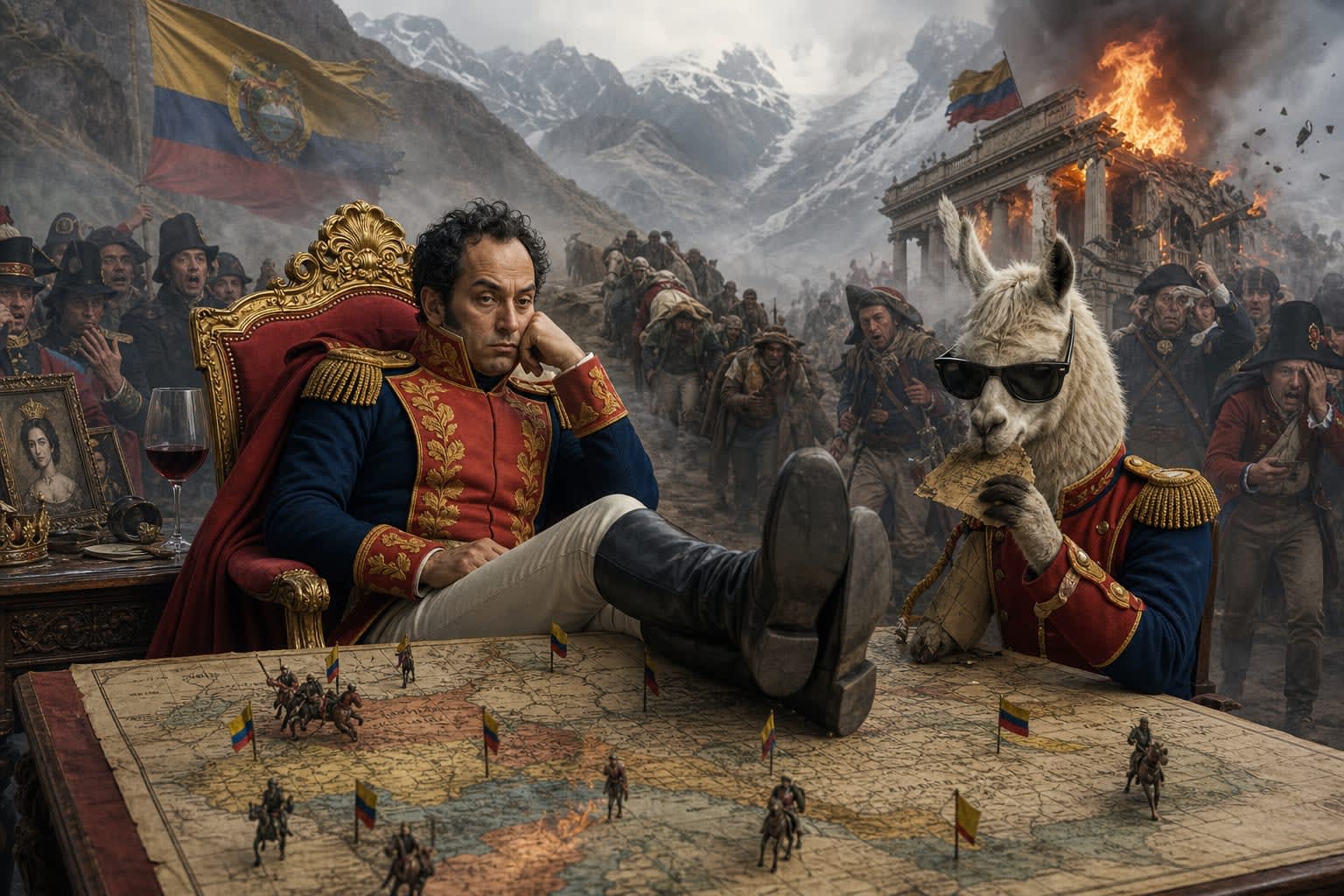
Simon Bolivar was not a saint, and that is precisely why the powerful fear him more than any saint in the Andes. He was the man who broke the chains of a continent and then watched, heartbroken, as the same continent forged new ones from its own hands. His story is not history. It is a wound that never closed, still weeping under the cathedral candles of Caracas.
They called him El Libertador. Born in 1783 into old-money aristocracy, the child of cacao and slaves, he could have spent his life sipping chocolate on a marble balcony while the poor cut cane in the sun until their spines curved like question marks.
Instead he burned his own inheritance for a dream.
The Boy Who Swore an Oath on a Roman Hill
Here is something few outside these lands know. In 1805, standing on Monte Sacro in Rome, a young Bolivar dropped to his knees before his old tutor and swore he would not rest until South America was free of Spanish rule. He was twenty-two. His wife was already dead of yellow fever, buried within a year of their marriage. He never remarried. Grief made him a nomad with an army.
Think of him crossing the frozen Andes in 1819 with barefoot soldiers, men from the flooded plains who had never seen ice, dying by the hundreds as the wind stripped flesh from bone. They came down the other side like ghosts and shattered the Spanish anyway at Boyaca. The absurd treated as normal. The impossible done because someone refused to accept it was impossible.
He freed six nations. Venezuela, Colombia, Ecuador, Peru, Panama, and the country that carries his name like a crown of thorns, Bolivia. Six. Count them on one hand and you run out of fingers.
The Betrayal Written in the Blood of the Poor
But listen closely, because this is the part they do not carve into the statues.
Bolivar dreamed of one great united America, a single body strong enough that no empire could ever swallow it piece by piece. He knew what was coming from the north. He warned that the United States seemed destined to plague the Americas with misery in the name of liberty. He said it in the 1820s. He was not wrong. He was early.
The landowners, the merchants, the men with clean fingernails, they wanted their little republics with their little borders so they could keep the poor exactly where the crown had left them. Bending in the fields. Coughing in the mines. Dying without a name.
So they broke his dream into fragments. And every fragment became a country ruled by the same families who had owned the plantations, the same faces wearing new medals.
The peasant who bled at Boyaca went home to the identical hunger. His grandmother still buried children before they learned to walk. His water still came from the same brown river. Freedom, it turned out, was a word for men who wore boots.
A Dead Man Who Refuses to Stay Buried
Bolivar died in 1830, poor, coughing blood, wearing a borrowed shirt because his own were in rags. The richest revolutionary in the hemisphere left this world owning almost nothing. Betrayed by the men he made powerful. He wrote that those who serve a revolution plow the sea.
Feel that sentence. Plow the sea. All that blood, all that ice, all those barefoot boys, and the water simply closes over the furrow.
And yet.
His bones were dug up, moved, paraded, exhumed again in 2010 for DNA tests amid whispers he had been poisoned. Governments still summon his name to bless whatever they are selling. Presidents kiss his sword. Generals invoke his ghost. He has become a political spirit that everyone claims and no one obeys.
Walk through Caracas at dusk. The heat presses down like a hand. Somewhere a radio plays an old joropo, and a woman lights a candle to a saint who has never answered. Above the plaza the bronze Liberator rides forever, green with age, streaked with the droppings of tropical birds who care nothing for empire.
The poor still sell mangoes at his feet. The poor who understood him best. They know what the palace forgets, that a man can free a continent and still fail to feed a single child, unless the freeing keeps going long after the statues are cast.
That is the true face of Simon Bolivar. Not the sword. Not the marble. The unfinished furrow in the sea, waiting for hands brave enough to plow it again.
He is not asking for your admiration. He is asking what you are willing to burn.