The New Scramble For Latin America: How The Mining Rush Is Leaving Your Grid On Borrowed Time
The green transition is not a moral awakening. It is a resource grab running straight through Latin America's watersheds and fragile grids, and the math does not balance in favor of the people standing on top of the lithium.
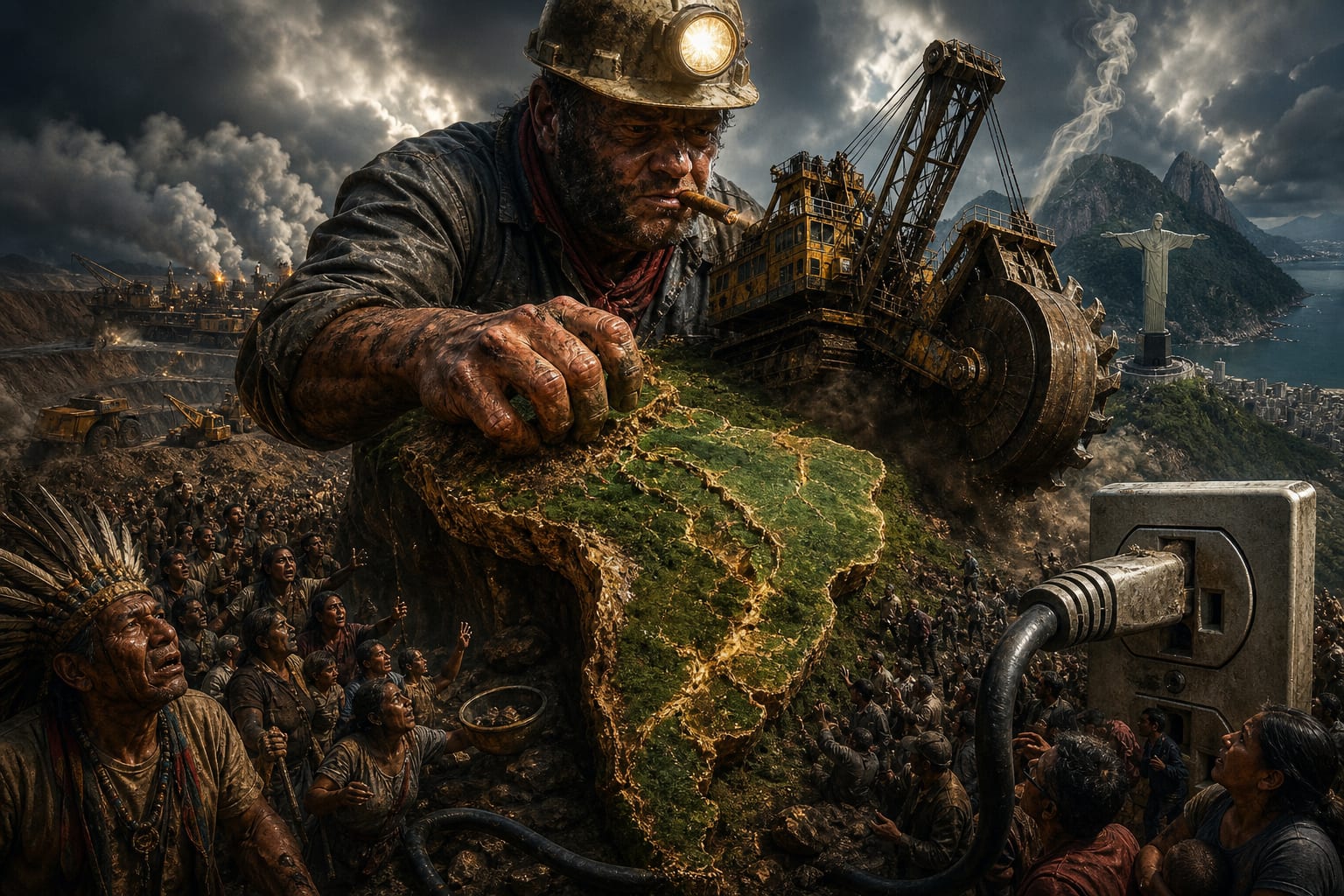
Let us dispense with the comforting fictions right now. The so-called green transition is not a moral awakening. It is a resource grab, and the map of that grab runs straight through the spine of Latin America, from the salt flats of the Andes to the copper corridors of Chile. The powerful economies of the world have decided that your electric future depends on somebody else's poisoned watershed. That is the equation, and it does not balance in favor of the people standing on top of the lithium.
I take the anti-imperialist position without apology. The geopolitics of mining is the oldest story on the continent wearing a battery-powered mask.
The Lithium Triangle Is A Sacrifice Zone
Consider the physics of it. Lithium brine extraction in the high Andean plateau consumes roughly 500,000 gallons of water per ton of lithium. In the Atacama, one of the driest places on the surface of this planet, that water is not a renewable convenience. It is a finite ledger being drained to zero.
The Lithium Triangle spanning Bolivia, Chile, and Argentina holds more than half of the world's identified lithium resources. The indigenous communities of the Salar de Atacama did not vote for their aquifers to become feedstock for luxury sedans in Munich and California.
Here is the surprise nobody prints in the glossy sustainability reports. When you pump brine from beneath a salar, freshwater from the surrounding basin migrates downward to replace it. The vegetation dies. The flamingos that fed on the microorganisms in those lagoons vanish. This is not projection. This is observation.
The Grid Runs On Borrowed Time
Now let us talk about what collapse actually feels like, because the academics never will. Ask anyone who lived through the 2019 Argentine blackout, when a cascading failure in the interconnection system left roughly 48 million people across Argentina, Uruguay, and parts of Paraguay without power on a single Sunday morning in June. One fault at a transmission node propagated through the entire Southern Cone in seconds. That is the fragility of a networked grid. It fails at the speed of electricity itself.
The math is brutal and indifferent. A power system operates on razor-thin frequency margins near 50 hertz. Drop the frequency by a few tenths and protective relays trip to save the hardware, dumping millions into darkness to preserve a substation.
In Venezuela in March 2019, the failure at the Guri hydroelectric complex, which supplies the majority of the nation's electricity, plunged the country into days of darkness. Hospitals lost refrigeration. Dialysis machines stopped. Water pumps that depend on electricity fell silent, so a blackout became a thirst crisis within hours. People carried buckets to the Guaire river, a channel of raw sewage, because the taps had died with the turbines.
A city does not starve slowly. It starves the moment the pumps stop and the cold chain breaks, and that moment arrives without warning.
Extraction Without End Is A Thermodynamic Lie
The working people of the Andes have watched this film before. Potosi in Bolivia was once the richest silver city on Earth. Spanish colonial mining consumed millions of indigenous and African lives in the mercury-choked tunnels of Cerro Rico over three centuries. The mountain is now so hollowed it is literally sinking. That is the honest preview of extractive capitalism. It takes the mineral, it takes the water, it takes the lungs, and it leaves a hole.
The names change. The mechanism does not. Today it is copper for Chinese and American manufacturers, lithium for battery consortiums, rare earths for the militaries that will guard the supply lines. Chile alone produces around a quarter of the world's copper, and its mines drink from an ocean of desalinated water pumped hundreds of kilometers uphill at staggering energy cost, because the freshwater is already gone.
Here is the seductive little joke of the whole enterprise. We are burning enormous quantities of energy to extract the materials that are supposed to save us energy. The efficiency curve bends toward zero. Every ounce of easily reached ore is already gone, so each new ton demands deeper pits, more diesel, more water, more crushed rock. Entropy is undefeated.
So understand what you are being sold. The clean future is being financed by draining the water basins of the poorest highlands on the continent and by strapping entire nations to grids that fail in cascades. The people paying that bill did not sign the contract. They simply live on top of the ledger, watching the drills descend while the reservoirs drop, doing the arithmetic that the boardrooms refuse to do. Run the numbers yourself. They do not come out in your favor.