The Report Card Was Wrong: Five Famous Dyslexics Who Turned School Failure Into Genius, From Einstein To Muhammad Ali
By Rafael Cortez ·
Read This First
This article is short on purpose.
Short sentences. One idea per paragraph. If reading is hard work for you, this piece was built for you.
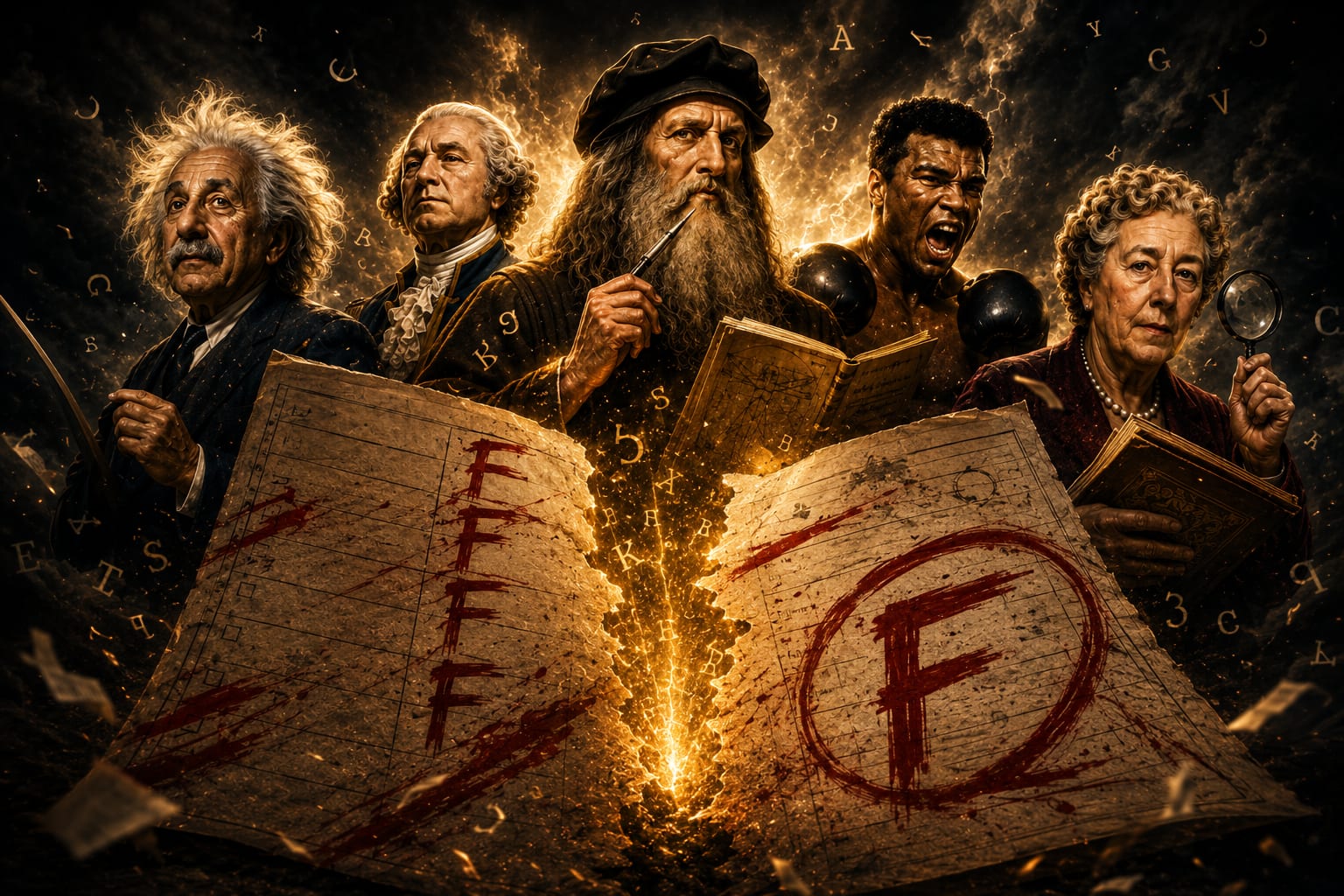
Here is the claim. Five of the most important people who ever lived showed signs of dyslexia. School punished them for it. Then the same trait that failed in the classroom won in the real world.
One honest note before the names. None of the five was ever tested as a child. The tests did not exist. Ali said it about himself out loud. Christie wrote it in her own autobiography in 1977. For Einstein, da Vinci, and Washington, experts argue from the evidence they left behind.
The evidence is loud.
The Man Who Thought In Pictures
Albert Einstein struggled with language and school rules. A 2012 paper highlighted his unusual learning path.
Here is the flip. Einstein did not think in words. He thought in pictures. As a teenager he imagined riding alongside a beam of light.
That daydream became the theory of relativity.
Bad for a spelling test. Perfect for rewriting physics.
The Man Who Wrote Backwards
Leonardo da Vinci wrote in mirror script. His notebooks jump from anatomy to flying machines to water on a single page. WebMD pointed to those traits in 2020.
A teacher would call that scattered.
History calls it range.
The jumping was the gift. He saw connections nobody else saw because his mind refused to stay in one lane.
The General Who Could Not Spell
George Washington had trouble with spelling and writing his whole life, according to Ron Chernow's 2010 biography.
So he built a different skill. He learned to read people instead of pages.
He put Alexander Hamilton at a desk and let the pen work for him. That is not a weakness patched over. That is command.
Knowing what you cannot do, and staffing it, is how nations get led.
The Fighter Who Composed Out Loud
Muhammad Ali admitted he had trouble reading. He said it plainly, in public. The University of Michigan's Dyslexia Help program lists him as a success story.
Now listen to what he did with words anyway.
The rhymes. The predictions. The trash talk that doubled as poetry. Ali could not lean on the page, so he built an oral memory most writers would kill for.
He composed in the air. Then he made the whole world memorize it.
The Novelist Who Could Not Spell Murder
Agatha Christie struggled with spelling and grammar her entire life. She said so herself in her 1977 autobiography. She called writing by hand slow and painful.
So she dictated. She built stories out loud, the way Ali built rhymes.
Look at the result. Her books are not prose showpieces. They are puzzles. Pattern, misdirection, structure.
The best-selling novelist in human history had a pattern brain, not a spelling brain.
A Word For Readers Who Grew Up Hearing "Flojo"
Across Latin America the clinical word is dislexia. The word kids actually get is flojo. Lazy.
Millions of children leave school believing it. They carry a stranger's mistake as their own shame.
The five names above are the answer to that lie. The brain was never the problem. The classroom measured one narrow skill and called it intelligence.
The Part Written Straight To You
School grades one thing. Reading and writing fast, under time, in silence.
That is one skill.
It is not thinking. It is not building. It is not seeing patterns, or reading people, or imagining light.
Einstein failed at the one skill. Da Vinci failed at it. Washington failed at it. Ali and Christie failed at it.
They failed at one skill and nothing else.
So if school made you feel broken, you are in heavy company. The report card measured the wrong thing.
You are not reading slowly. You are thinking differently.
And history keeps getting remade, quietly, by minds exactly like yours.