Trump's Generic Drug Tariff Gamble Could Reshape the Medicine in Your Bloodstream
Trump's phased tariff plan on generic drugs starts at zero but climbs to a crushing 200% by 2029, threatening the global supply chain behind nearly half of America's cheapest medicines.
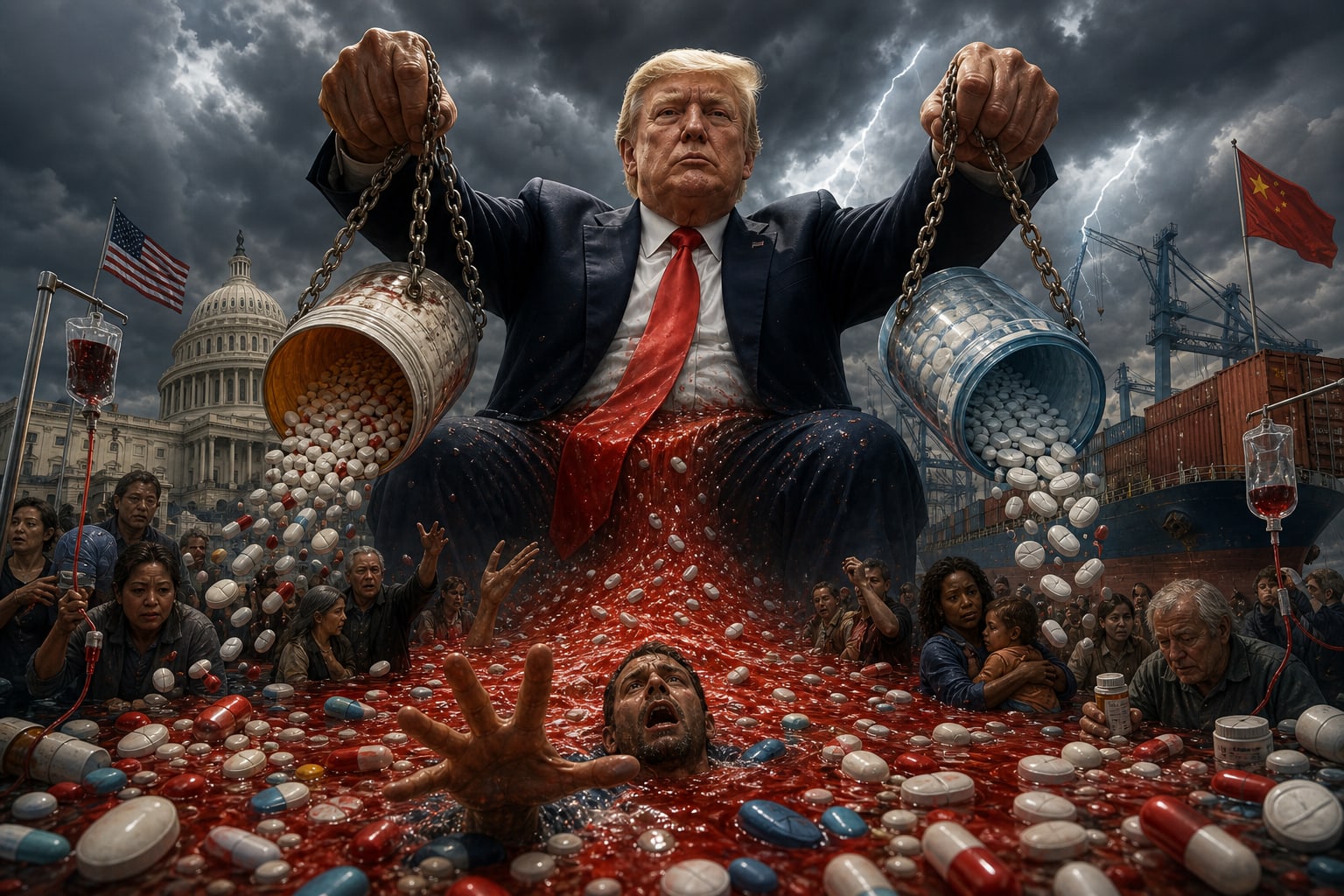
Somewhere in your body, right now, there is a molecule that traveled halfway around the planet to keep you alive.
Maybe it is thinning your blood. Maybe it is calming a racing heart, or beating back an infection that would have flattened your grandparents. And here is the part that should stop you cold: that molecule was very likely born in a factory in India or China, cooked up in vast steel vats, then shipped across oceans into the little orange bottle rattling around in your medicine cabinet.
The pills you swallow without a second thought are not really American. They are global travelers. And President Donald Trump just announced a plan that could yank the entire supply chain apart at the seams.
The Slow-Motion Explosion 💊
On Tuesday, Trump revealed a phased tariff schedule for generic drugs entering the United States. Generics are the unglamorous workhorses of medicine, the cheap copies of brand-name pills that keep prices low and pharmacies stocked.
The plan works like a fuse burning toward dynamite:
August 2026: Zero tariffs. A two-year grace period begins.
August 2028: A 100% tariff detonates.
August 2029: The rate doubles to a staggering 200%.
Trump described the escalating fees as a straight-up penalty, aimed at companies that refuse to build their factories and facilities on American soil during the window he is offering. Move onshore, or pay the price.
It is a tariff structured like a countdown clock, and everyone in the pharmaceutical world can hear it ticking.
Why This Is a Very Big Swing
Let us be honest about the scale here, because it is genuinely enormous.
Indian pharmaceutical companies supply nearly half of every generic medicine consumed in America. Nearly. Half. Sit with that number for a moment. When you reach for a cheap prescription, there is roughly a coin-flip chance it rolled off a production line in India.
And the United States is not a minor customer for India either. America gobbles up about a third of the country's total pharmaceutical exports every year, mostly the affordable versions of drugs that Americans depend on to survive the month.
The medicine cabinet is not just a shelf. It is a supply chain stretched taut across three continents, and Washington just grabbed one end and pulled.
Then there is China, lurking upstream in the story like the plumbing you never see. Chinese firms dominate the production of active pharmaceutical ingredients, the raw chemical building blocks of drugs like amoxicillin and heparin. Even a pill stamped and packaged somewhere else may owe its beating heart to a Chinese factory.
So the tariff is not aiming at one target. It is aiming at an entire interlocking web that took decades to build.
The Fine Print Nobody Reads 🔍
Here is where it gets deliciously complicated, and where the whole thing starts to feel less like policy and more like a game of chess played with human health.
Tariffs on patented and branded drugs, the flashy expensive newcomers, are staying exactly where they are. Back in April, Trump slapped a 100% levy on patented pharmaceutical products and ingredients under a national security provision, while quietly exempting generics, biosimilars, and their ingredients.
Larger drugmakers got a 120-day cushion before that 100% rate kicked in. Smaller companies, the ones leaning on contract manufacturers to make their products, got 180 days.
And then there is the escape hatch.
More than a dozen major drugmakers, including household giants like Eli Lilly, Pfizer, and Novo Nordisk, have already cut deals with the administration to lower the prices of their medicines. Those agreements fold into Trump's so-called most favored nation policy, which ties what Americans pay to the cheaper prices patients enjoy in other wealthy countries.
The reward for playing ball? A three-year exemption from tariffs.
It is a carrot and a very large stick, swung with theatrical force.
The Human Cost Hiding in Plain Sight
Strip away the trade jargon and the truth sits there, quiet and heavy.
Generic drugs are cheap for a reason. They are cheap because they are made in enormous quantities in places where production costs stay low. That cheapness is not an accident. It is the entire point. It is what lets a diabetic afford insulin analogs, what keeps a heart patient in blood thinners, what lets a parent fill a child's antibiotic prescription without emptying the bank account.
When tariffs pile onto imported medicine, the cost does not vanish into thin air. It settles somewhere. And that somewhere is often the pharmacy counter, where a real person is deciding between their prescription and their groceries.
The gamble: That American factories will rise up during the grace period, replacing the overseas supply before the tariffs bite. The risk: That they will not rise fast enough, leaving shortages and higher prices in the gap.
Building a pharmaceutical plant is not like flipping a switch. It takes years, regulatory approval, skilled workers, and specialized equipment. Two years is a blink in the world of drug manufacturing. Whether companies can realistically relocate an ocean's worth of production in that time is the enormous open question hovering over the entire plan.
A Nation That Forgot How to Make Its Own Medicine
The uncomfortable backstory here is that America did not accidentally end up depending on foreign factories for its pills. It chose this, slowly, over decades, because cheaper was easier and someone else was always willing to do the messy chemical work.
Now the country is discovering what happens when the pipeline it built starts to feel like a vulnerability. Trump's argument leans on national security, the idea that a nation unable to produce its own essential medicines is a nation with a dangerous soft spot.
There is a real logic buried in that fear. A country that cannot make heparin or amoxicillin in a crisis is genuinely exposed. Pandemics, wars, and diplomatic breakdowns have all proven how quickly a global supply chain can snap.
But logic and consequences do not always travel together. The same policy meant to protect Americans in some distant emergency could squeeze them right now, at the register, month after month, long before any new factory opens its doors.
What Happens Next ⏳
For the next two years, nothing changes at the pharmacy. Zero tariffs means the pills keep flowing at the prices people know.
But underneath that calm surface, a frantic scramble has already begun. Executives in boardrooms from Mumbai to New Jersey are running the numbers, weighing the brutal cost of building on American soil against the even more brutal cost of a 200% tariff waiting at the end of the runway.
Some will build. Some will strike deals. Some will bet the whole thing gets reversed, delayed, or watered down before the fuse ever reaches the powder.
And ordinary people, the ones who never asked to be part of a trade war, will keep swallowing their pills and hoping the molecule that keeps them alive still finds its way into the bottle, at a price they can afford to pay.
The countdown clock is running. Everyone can hear it. What nobody knows yet is exactly what happens when it hits zero.