Trump’s $1.4 Billion Crypto Windfall: Could His Tax Bill Be $250M to $518M?
President Trump’s July 2, 2026 disclosure shows $1.4 billion from crypto. Experts say taxes could range from $250 million to $518 million. Opaque corporate structures and a controversial DOJ settlement keep the true bill hidden.
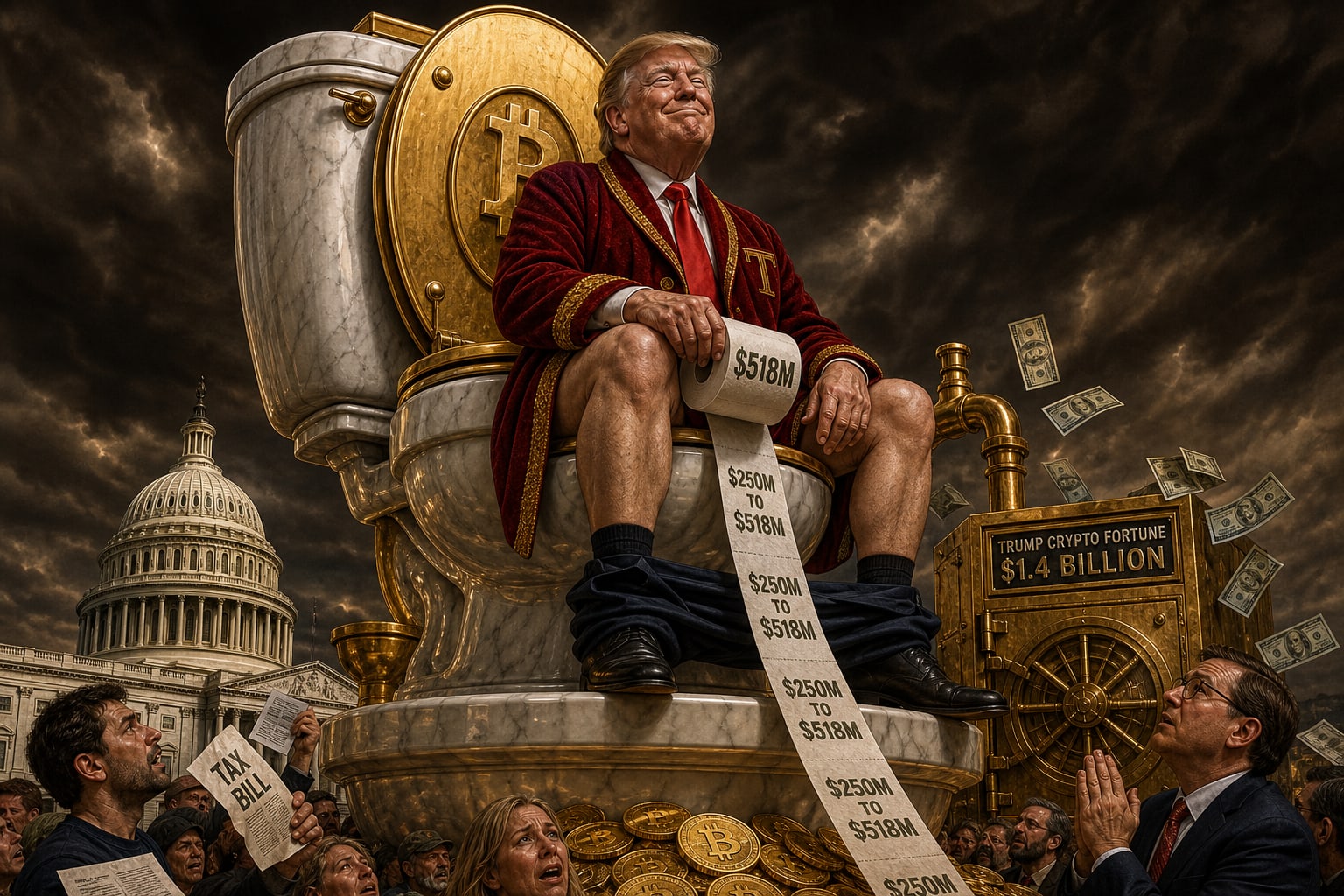
President Trump’s latest financial disclosure has a new number that stinks of secrets. It says he made $1.4 billion from crypto ventures. The disclosure appeared on July 2, 2026. The sum has tax experts squinting into a black box.
What the Numbers Show
The disclosure lists $625 million tied to a $TRUMP meme coin. That amount is described as a royalty from a licensing deal with a company called Celebration Coins. It also shows more than $590 million paid by World Liberty Financial. That payment came from token sales and the sale of an equity stake.
If the whole $1.4 billion were taxed as individual income at the top federal rate of 37 percent, the bill would be $518 million. One accountant who handles crypto income said it is reasonable to think the president would have to pay at least $250 million on this money. The gap between $250 million and $518 million is the size of the mystery.
Why the Bill Is a Mystery
The IRS treats digital assets like other investment gains. But the disclosure gives only thin descriptions. That makes it impossible to tell if the money is capital gains or ordinary income. If it is ordinary income it could face higher ordinary tax treatment. If capital gains, different rules apply. The law professor Omri Marian, who specializes in crypto taxation, called the situation a black box. He said he cannot see inside the corporate structures that hold the income.
Mr. Trump does not release his tax returns. The White House declined to answer questions about whether the crypto income was taxed to the president personally or to businesses. It also did not say whether operating losses were used to offset gains. Without those answers the math is guessing, not accounting.
Legal Cover and Political Fallout
The legal picture adds more smoke. In May 2026 the Justice Department signed a settlement that said the IRS and Treasury are forever barred and precluded from pursuing claims based on prior tax returns. The settlement also created a more than $1.7 billion anti-weaponization fund. That fund was supposed to pay people who said they were victims of government lawfare. The fund drew outrage from both Democrats and Republicans. A federal judge paused its creation. Acting Attorney General Todd Blanche later told Congress the Justice Department was not moving forward with the fund.
Those moves do not clarify how much tax was paid on the crypto gains. What they do is show how legal deals can lock away questions. That leaves the public guessing about hundreds of millions in potential federal revenue.
Why It Matters to Ordinary People
Taxes are not a private dinner for the rich. They pay for schools, hospitals and roads. If a president’s taxable income sits inside opaque entities, ordinary citizens cannot verify whether the government collected what it was owed. That is a democratic problem as much as a tax one.
The human cost is trust. The public sees a $1.4 billion headline and wonders if the rule of law applies to everyone. The accountant’s estimate of at least $250 million in taxes shows the scale. The top-rate estimate of $518 million shows the stakes. Either number is big enough to matter to budgets and services.
"What we know is that he did very well for himself, but we do not know how beneficial ownership is structured," Omri Marian said.
The journalist outlet that highlighted the disclosure was CBS News. The outlet noted the limited descriptions on the disclosure and the difficulty of determining tax consequences without more transparency.
A Latin Comparison Americans Might Not Know
In parts of Latin America people have learned to read two things at once. They learn how an official story hides a secret ledger. For example, citizens in some countries use apps to report protests. That little-known fact shows how digital tools can be turned into instruments of power and secrecy. Here the digital tokens promise transparency while the tax story is closed off.
The settlement’s anti-weaponization fund and the 2020 leak of tax returns show how political fury and legal deals can tangle with plain accounting. The fund was more than $1.7 billion. The 2020 episode involved leaked tax returns that fed political headlines. Those events matter because they changed how people trust institutions.
Officials say the settlement protects against weaponization of tax returns. That is the official argument. It is an argument about privacy and safety. It is also an argument that hides a problem. The problem is that sealing off tax scrutiny can prevent the public from knowing whether the state collected what it should. That leaves millions in doubt. It leaves decisions about public money in the dark.
The very size of the numbers makes this urgent. $1.4 billion. $625 million. $590 million. $250 million. $518 million. These are not hypothetical sums. They are the sums whispered in a black box. They demand daylight.
Seven words still matter: transparency, ownership, tax law, public trust, accountability, settlement and pause. Those are the levers. Right now they are stuck.