Trump's Son-in-Law Lands at the Oil Table—No Job Required
Michael Boulos holds no government job. Yet Trump's son-in-law sat beside Marco Rubio at an official UAE meeting on oil, Iran, and the Strait of Hormuz. The episode exposes how family patronage now shapes U.S. energy policy—with direct stakes for Venezuela.
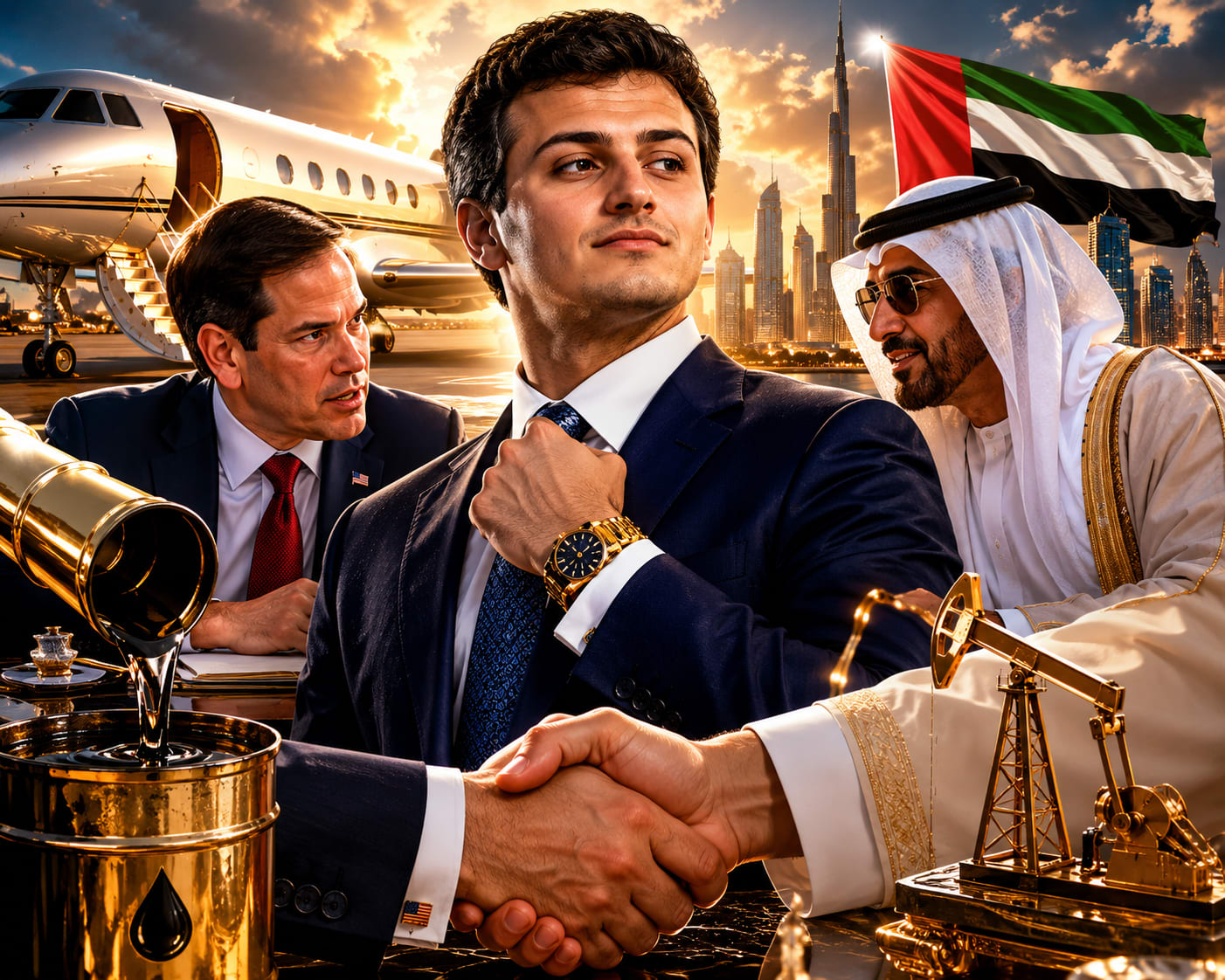
A FRIEND OF THE FAMILY, A SEAT AT THE EMPIRE
Michael Boulos has no government job. None.
Yet there he sat. Beside the U.S. secretary of state. Inside an official meeting with the ruler of the United Arab Emirates.
The photo went out on Marco Rubio's own account. Boulos in the middle of the table. Flanked by diplomats. Next to UAE President Mohamed bin Zayed Al Nahyan.
Boulos is married to Tiffany Trump. That is his entire résumé for the room.
The talks were not minor. Rubio said they covered President Trump's memorandum with Iran. They covered the Strait of Hormuz. They covered regional stability. They covered oil.
A reporter asked the obvious question. Why was Boulos there?
Rubio stumbled. "He was there to see his brother that lives here," he said. "I'm a good friend of Michael's, so we had a chance to catch up."
A good friend. At a working lunch. About Hormuz and Iranian crude.
WHEN A FAMILY BECOMES A GOVERNMENT
Latin Americans know this script by heart.
We call them círculos de poder. Circles of power. Relatives and friends who appear in state negotiations with no mandate, no oversight, no accountability.
We have watched our own presidents hand the wheel to sons-in-law and business partners. We have watched public office melt into private fortune.
Now Washington runs the same play.
Boulos is not Jared Kushner. Kushner at least carried a formal title. Boulos carries nothing but a marriage license.
Donald Trump Jr. and Eric Trump broker deals across the globe. Their father runs the country. The connection is never spoken aloud. It does not need to be.
This is how patronage works. The family is the institution. The handshake replaces the law.
The danger is not protocol. The danger is access. Whoever sits at that table shapes policy. Whoever shapes policy moves money.
OIL, SANCTIONS, AND WHO REALLY PAYS
This story is not just about a wedding photo. It is about leverage over the world's energy supply.
The UAE pledged roughly $1.4 trillion in U.S. investment over a decade. Gulf capital flows into Washington. Trump-linked businessmen appear at Gulf tables. The lines blur on purpose.
And the topic on the table—oil and sanctions—lands hard on Venezuela.
Since January, Washington has taken effective control of Venezuela's transition. U.S. forces seized Nicolás Maduro on Jan. 3. He sits in an American courtroom now. Delcy Rodríguez governs as acting president.
Diplomatic ties resumed in March. Sanctions are easing. But the United States keeps oversight of Venezuela's oil revenues.
Read that again. A foreign power now manages who profits from Venezuelan crude.
The oil belongs to the Venezuelan people. It should fund their hospitals. Their schools. Their pensions. Not American oil firms. Not informal brokers in Gulf hotels.
When energy policy is set by presidential relatives over working lunches, the working class loses. In Abu Dhabi. In Caracas. Everywhere.
The same hands that decide Hormuz transit decide Venezuelan output. The same circle that profits from access profits from scarcity.
THE COST OF GOVERNMENT BY HANDSHAKE
Defenders will call this overblown. A friend caught up with a friend. Nothing more.
But the secretary of state could not explain it. He stammered. He repeated himself. He fell back on "good friend" because there was no institutional answer to give.
That silence is the story.
Foreign policy is supposed to run through elected officials and confirmed diplomats. It is supposed to be answerable to the public that pays for it.
Instead, the most sensitive negotiations on earth now feature unelected family members. Energy. Sanctions. Iran. The fate of nations decided by people no voter ever chose.
This is not democracy promotion. It is democracy hollowed out from within.
For Venezuela, the warning is sharp. A democratic future must mean a state free to trade on its own terms. With Washington. With Beijing. With anyone. But on terms its own people set.
It cannot mean swapping one set of unaccountable power brokers for another. It cannot mean Maduro's kleptocracy replaced by foreign patronage and oil deals cut in private.
The boy at the table holds no office. He answers to no one.
Neither, increasingly, does the empire he sits inside.