The Wasp Network: How Havana's Spies Died to Save Miami From the Empire's Terror
They were not soldiers or assassins. They were spies sent to stop bombs from reaching Havana, and the empire buried them in chains while the real terrorists retired in Miami sunshine.
By Martin Alvarez ·
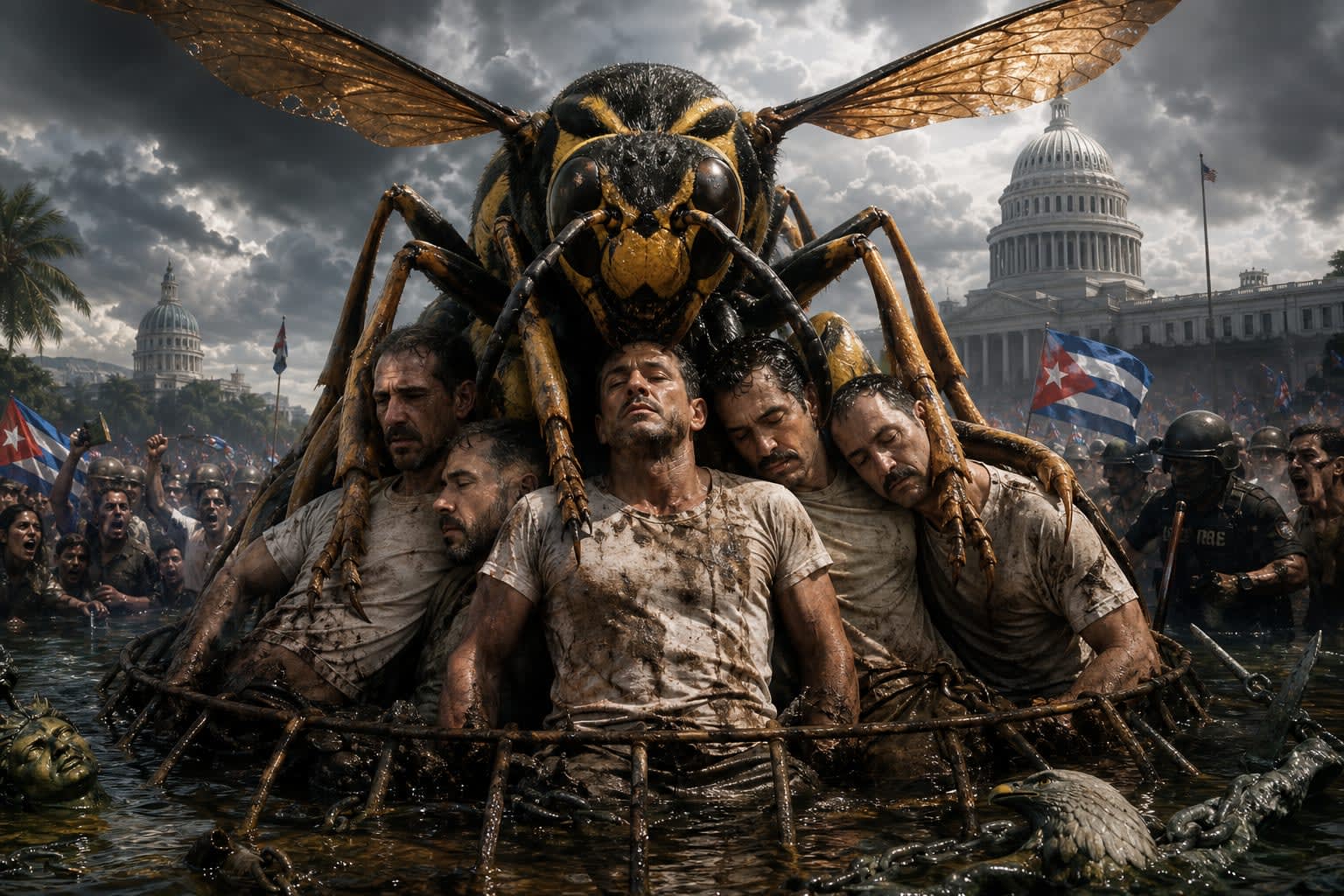
They were not James Bond. They were factory workers, pilots, waiters, and a woman named Ana who kept files under her bed. And Washington called them the most dangerous men in America.
The story of the Wasp Network is the story of a lie so large that it swallowed an entire courtroom in Miami and spat out five men wrapped in chains. But the lie starts earlier, in the blood-soaked years when Cuban exiles, funded and forgiven by the empire, turned South Florida into a launchpad for bombs.
The Bombs Nobody Wants You to Remember 💣
Let us begin where the official history refuses to begin. Not with Fidel. Not with communism. But with the corpses.
In 1976, a Cubana airliner exploded in the sky over Barbados. Seventy-three human beings fell into the sea. Among them was the entire Cuban youth fencing team, teenagers who had just won gold. The men accused of planning it, Luis Posada Carriles and Orlando Bosch, lived out their days sipping coffee under the warm protection of the United States.
Bosch died free in Miami. Posada died free in Miami. The children they scattered across the ocean never got old enough to vote.
This is the detail the schoolbooks skip. The terror ran from Florida toward the island, not the other way around. Hotels bombed. Tourists killed. An Italian visitor named Fabio Di Celmo bled out in a Havana lobby in 1997 because a bomb was planted to scare away vacationers.
So Havana Sent Spies, Not Soldiers 🐝
Here is the twist that drives the empire crazy.
Cuba did not send tanks. It could not. So it sent people. Quiet people. They melted into the exile community, joined the loud anti-Castro groups, and listened. Their mission was almost boring in its decency: find out where the next bomb was coming from, and stop it before more bodies dropped.
They called themselves La Red Avispa. The Wasp Network.
The most famous of them was Gerardo Hernández. There was René González, a pilot. There was Antonio Guerrero. There was Fernando González and Ramón Labañino. Five men who would become known worldwide as something the propaganda machine hated to hear spoken aloud.
The Cuban Five.
The Great Miami Trial Circus 🎪
In 1998, the FBI swept them up. And here the story turns from tragedy into something Kafka would have blushed to invent.
They put five Cuban agents on trial in Miami. Miami. The one city on planet Earth where a fair jury for accused Cuban spies was as likely as snow in the Malecón.
Think about it for a heartbeat.
- The judge sat in the heart of the exile stronghold.
- The jurors lived among the very groups the spies were watching.
- The prosecution wrapped everything in the flag of national security.
Years later, a higher court would admit the obvious, that the location poisoned the whole thing, before that ruling was reversed by men in robes who preferred the comfortable version of justice.
The Murder Charge That Made No Sense
Gerardo Hernández was hit with the heaviest hammer they had: conspiracy to commit murder.
The charge came from the Brothers to the Rescue affair. In 1996, Cuban jets shot down two exile planes that had been buzzing the island's airspace, dropping leaflets, daring the sky. Four men died. It was a real tragedy and a real provocation, all tangled together.
The empire pinned it on Hernández, claiming he helped plan the shootdown. The evidence was thin as tissue paper. Even the prosecutors quietly wobbled on it. But the verdict came down like an anvil.
Two life sentences. For a man whose actual job was trying to keep bombs out of Havana hotels.
The Woman History Tried to Erase 🔥
Ana Margarita Martínez has her own chapter, and so does the forgotten fact that these networks were never just a boys' club of intrigue.
Cuban women ran couriers, decoded messages, and carried the weight of a war fought in whispers. The memory of the revolution has always leaned on women who did the invisible labor and then got written out of the poster. The Wasp Network was no different. The archives remember the five male faces. They forget the hands that typed, hid, warned, and endured.
The Slow, Stubborn Fight to Bring Them Home
Then something the empire did not expect happened. The world got loud.
Committees formed across continents. Nobel laureates signed letters. Nelson Mandela spoke their names. Ordinary people who had never seen Havana learned five Cuban names by heart and refused to let them rot silently in supermax cells.
Fifteen years crawled by. Men lost their marriages, their parents, their youth behind American walls.
And in December 2014, in the same handshake era that cracked open the frozen door between Washington and Havana, the last of them walked free. Traded. Released. Returned. In Cuba they came home not as prisoners but as heroes, faces on billboards, taught to children.
What The Empire Buried
The neat American story goes like this: Cuban spies infiltrated Florida, got caught, went to prison, end of lesson.
But peel that back and the rot underneath smells different. It smells like airliners falling into the Caribbean. It smells like terrorists retiring peacefully in the sunshine while the men hunting them wore the chains.
The Wasp Network was a mirror held up to a superpower. And the superpower did not like its own reflection. So it locked the mirror in a cell for fifteen years and hoped the world would look away.
The world blinked. But it did not forget. And neither should anyone who still believes the dead children of that Cubana flight deserved a single honest sentence in the history books.