Witkoff and Kushner Head to Qatar as Iran Hardliners Demand Revenge for Khamenei
Steve Witkoff and Jared Kushner fly to Doha as Tehran’s hardliners call for revenge after Ayatollah Khamenei’s death. The fragile U.S. Iran framework faces 60 days to hold — or explode.
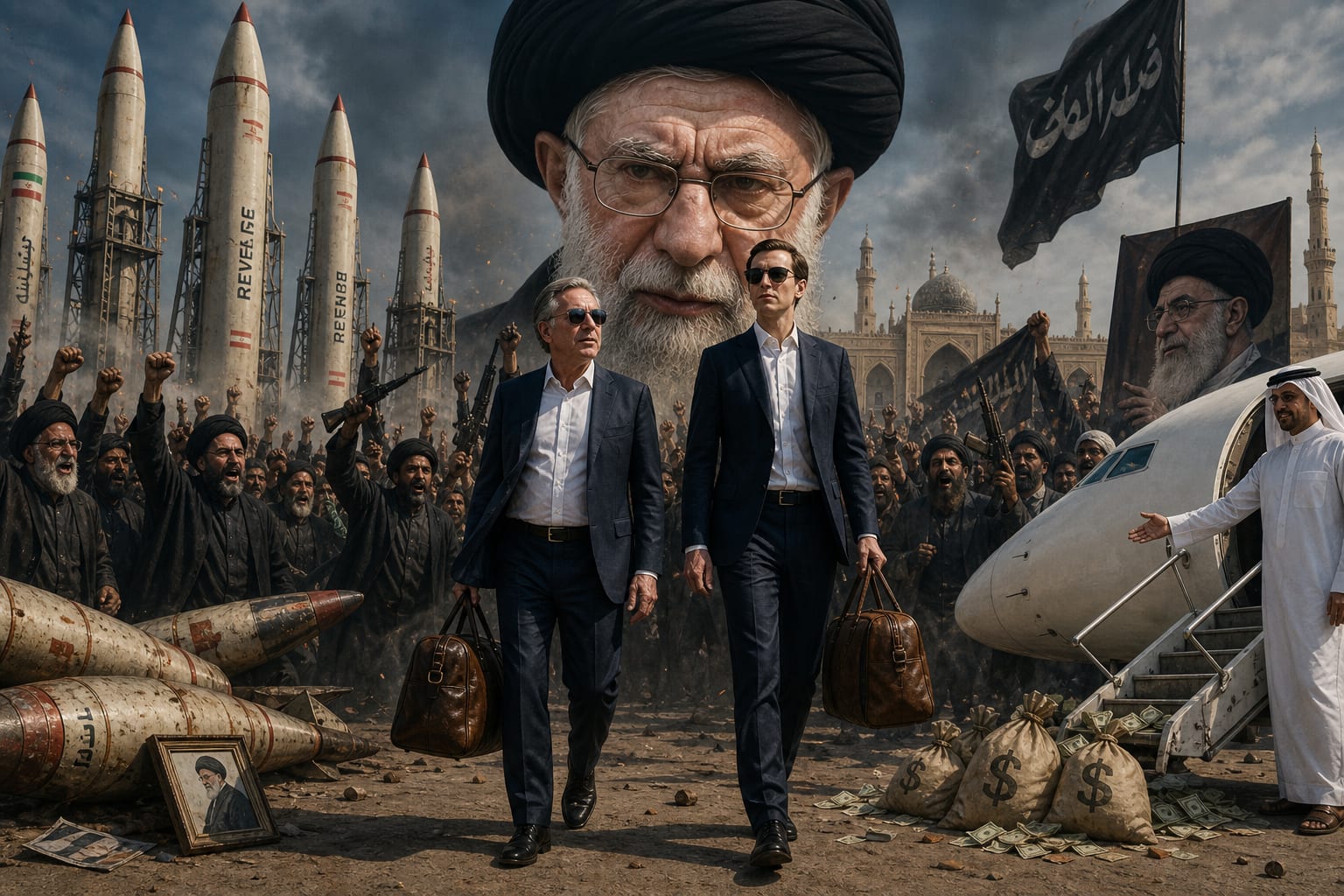
Doha looks like a fragile stage. Two American envoys arrive with grand promises. Hardliners in Tehran answer with threats of blood on American soil. The clock is ticking and the world holds its breath.
A Fast Track to Diplomacy and Danger
U.S. Special Envoy Steve Witkoff and Jared Kushner will fly to Doha on Tuesday for talks with Qatari mediators and Iranian officials. The meetings aim to push toward a final deal to end Tehran's nuclear program.
A U.S. official told reporters that Iran's leaders have about 60 days to make "tough decisions" that could benefit the Iranian people and bring relief. Technical teams from both the U.S. and Iran are set to meet separately with mediators from Qatar and Pakistan in the days after the envoys arrive.
President Donald Trump said Monday the Doha meeting is "perhaps important, perhaps not" and added "we're winning militarily," while claiming that Iran requested the talks.
Hardliners Answer With Calls For Revenge
The memorandum of understanding that opened the door to talks remains fragile. The deal has already been threatened by near exchanges of strikes between the U.S. and Iran near the Strait of Hormuz.
Conservative voices in Iran erupted after the death of Supreme Leader Ayatollah Ali Khamenei. A mural of Khamenei and Gen. Qasem Soleimani appeared in Tehran ahead of a planned funeral ceremony, a vivid sign of how raw sentiment is.
Hussein Shariatmadari, the supreme leader's representative and editor in chief of the conservative newspaper Kayhan, wrote that “the effort to avenge the Supreme Leader must take place on American soil itself.” Shariatmadari was hand picked by Khamenei to run Kayhan and urged that any final deal should demand President Trump be extradited to Tehran to face trial.
Sixty members of Iran's 88 member Council of Experts signed a rare public rebuke on Saturday. Their letter called Trump the "criminal president of the United States" and said anyone with access to Trump or Israeli Prime Minister Benjamin Netanyahu had a religious duty to bring them to justice. The Council also warned that negotiators should be barred from discussing Iran's nuclear program.
Washington Pushes Back, Tehran Is Divided
The White House pushed a different story. Olivia Wales, a White House spokeswoman, said the MOU is "an excellent, performance based MOU that advances the interests of the United States by ending the fighting, reopening the Strait of Hormuz to significantly lower energy prices, and forcing Iran to commit to abandon its nuclear ambitions."
U.S. officials say Iran agreed to meet benchmarks in exchange for humanitarian relief. Iranian media report that Tehran's technical teams will press for payouts tied to a pledged $6 billion in unfrozen assets under the MOU.
But Iran is not a single voice. President Masoud Pezeshkian defended negotiators in a statement, accusing critics of trying to halt a constructive process and calling attacks on the team unfair. Senior cleric Ayatollah Alavi Boroujerdi praised Pezeshkian and called the diplomatic push "courageous and commendable."
Why This Matters and What Could Happen Next
The danger is clear. Hardliners calling for revenge on American soil raise the risk of violent retaliation that could widen the conflict. The reopening of the Strait of Hormuz was slammed by the Council of Experts as a "strategic mistake" that could embolden the enemy to break the agreement.
The human cost is already visible. The death of Khamenei and the planned funeral stir deep emotion. Economic pain in Iran is severe. A U.S. official warned that the Iranian economy is in freefall, with massive food shortages and rising prices that put pressure on leaders to find relief fast.
If mediators fail, the fragile MOU could collapse. That could bring fresh strikes around the Strait of Hormuz and new sanctions or military moves. If it holds, Iranian technical teams may secure part of the $6 billion in assets, easing some immediate pain for ordinary people.
Americans may view these scenes as distant drama. I see them as a repeat of old scripts. The talk of extraditions and public calls for punishment feel like tribunals of revenge. It echoes the era when foreign powers bargained with crowns and bosses while the poor paid the bill. For those of us who remember Latin American interventions, this looks like the moment before a new round of foreign pressure and domestic fracture.
The envoys step into Doha with a thin promise. Tehran's hardliners shout for blood. The clock for decisions is 60 days. The world will watch whether diplomacy can outpace fury, or whether the Strait of Hormuz becomes the next theater in a fight that could reach American streets in name and consequence.
Dark humor helps. Diplomacy smells like a hotel conference, while threats smell like funeral incense and gunpowder. Either way something will be lost. Likely it will be not the policy papers but ordinary lives.