The Ratlines to Buenos Aires: How Argentina Became a Safe House for Hitler's Butchers
Argentina did not accidentally shelter Nazis. It built the ratlines, forged the passports, and welcomed Hitler's butchers with open arms. The buried truth of a nation that became a hotel for mass murderers.
By Martin Alvarez ·
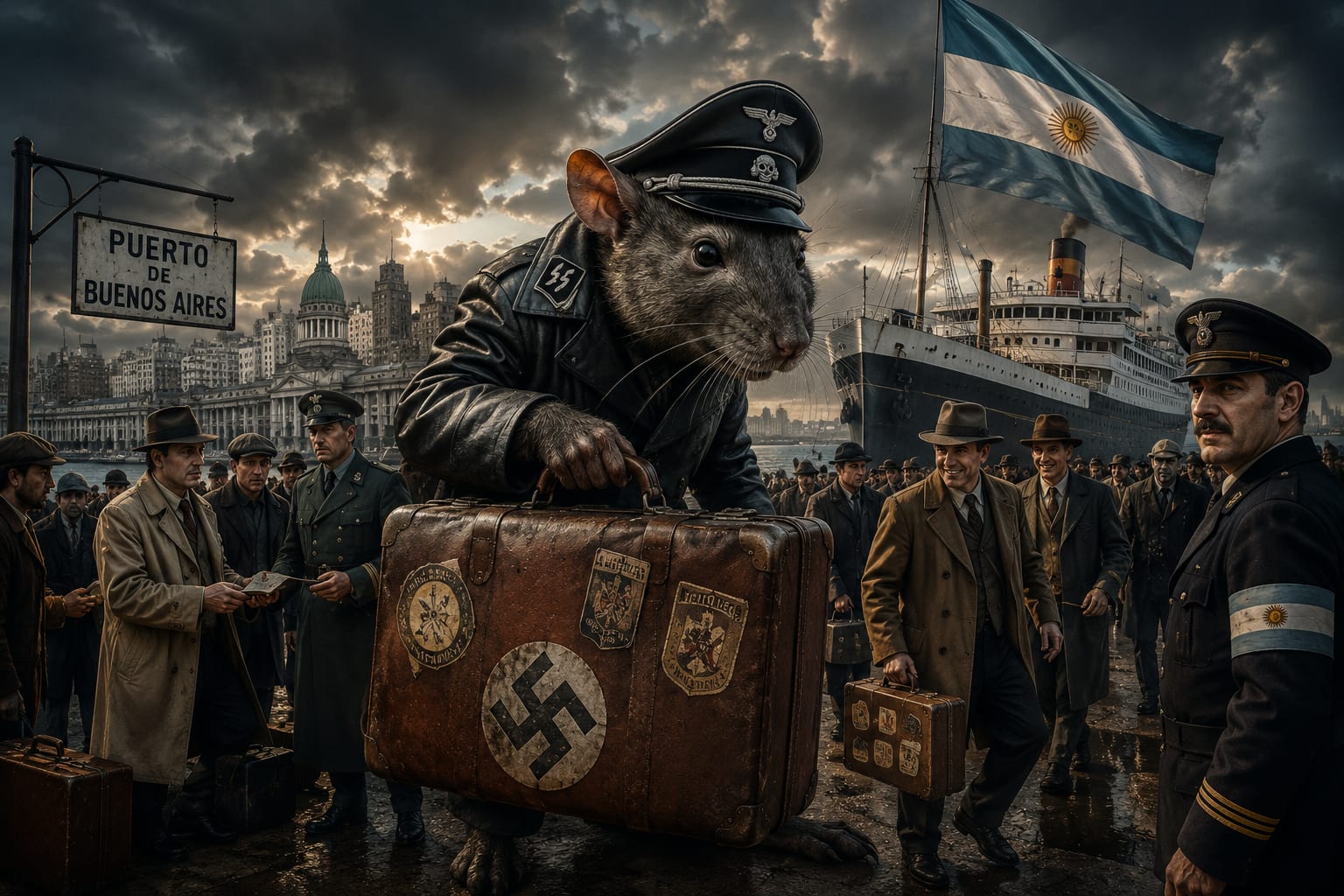
Argentina did not accidentally trip over a suitcase full of Nazis. It rolled out the red carpet, kissed them on both cheeks, and handed them a passport with a shiny new name.
This is the story they buried under decades of official denial. The story of how a South American country, drunk on the fumes of European fascism, turned itself into a hotel for mass murderers who had blood dried under their fingernails.
And the front desk clerk? A president named Juan Domingo Perón. 🇦🇷
The Escape Route Had a Name
They called them the ratlines. A perfect word, really. Rats fleeing a sinking ship, scurrying through sewers and mountain passes, dragging their crimes behind them.
When the Third Reich collapsed in 1945, the worst men in Europe needed a place to disappear. Not a prison cell. Not a hangman's rope. A place with steaks, sunshine, and a government that would look the other way while whistling a happy tune.
Buenos Aires answered the call. The city of tango and elegant boulevards became the final destination for men who had engineered the deaths of millions.
The route ran through Italy, greased by certain corrupt hands inside Vatican circles who issued Red Cross travel documents to war criminals. From the ports, the ships sailed across the Atlantic. And on the other side, Argentine officials stamped the papers without blinking.
The Guest List From Hell
Let us name the monsters, because history has a nasty habit of letting them slip into the shadows.
Adolf Eichmann. The cold-eyed bureaucrat who organized the transport of Jews to the death camps. He lived in Argentina under the name Ricardo Klement, working at a Mercedes-Benz plant, riding the bus home like an ordinary man. For years he raised his family in a quiet neighborhood while the ghosts of his victims filled the sky.
Josef Mengele. The so-called Angel of Death from Auschwitz. The man who performed grotesque experiments on children and twins. He walked the streets of Buenos Aires as a free man, protected, comfortable, and utterly unpunished.
Erich Priebke. Responsible for a massacre in Italy. He fled to the mountain town of Bariloche and lived there for decades as a respected local businessman, running a delicatessen, greeting tourists with a smile.
Imagine buying your Sunday sausage from a man who had ordered the slaughter of hundreds. That was not fiction in Argentina. That was Tuesday.
Why Would a Country Do This?
Here is where the powerful want you to stop asking questions. But the answer is uglier than the crime itself.
Perón's government was fascinated by fascist Europe. It admired the discipline, the industry, the twisted efficiency. Argentina wanted the scientists, the engineers, the military minds who had served the Reich. It figured that if it could harvest their knowledge, it could build weapons, factories, and power.
So the government made a cold calculation:
- The Nazis had skills.
- The Nazis had money looted from their victims.
- The Nazis had nowhere else to go.
And a desperate rat pays well for a hiding place. 💰
Perón even set up secret channels, with agents in Europe helping to arrange the passages. This was not a bunch of criminals slipping through the cracks. This was policy. This was organized by the state, signed off by men in nice suits sitting in government offices.
The Hunt That Broke the Silence
For years the myth held. Argentina pretended it knew nothing. The Nazis grew old and fat in their comfortable exile.
Then in 1960, Israeli agents crept into a Buenos Aires suburb and grabbed Eichmann off the street. They smuggled him out of the country, put him on trial in Jerusalem, and hanged him. The world finally saw one of the ratline passengers dragged into the light.
But Mengele was never caught. He drowned off a Brazilian beach in 1979, an old man who had escaped every court on earth. Justice never touched him. He died with sand between his toes.
Priebke was finally extradited in the 1990s after a journalist confronted him on camera. The old man admitted his crimes with the calm of someone discussing the weather.
The Money Was Never Clean
Do not forget the gold. 🪙
The Nazis did not arrive empty-handed. They carried wealth stolen from murdered families, gold pulled from the mouths of the dead, art ripped off the walls of ransacked homes. Some of that treasure flowed into Argentine banks and businesses.
The country did not just shelter the killers. It profited from the plunder. The blood money became part of the economy, laundered through respectable institutions, invisible in the ledgers of the wealthy.
A nation can build monuments and write proud anthems, but the foundation still remembers what it was built on.
The Lie That Lasted Generations
For half a century, official Argentina denied the scale of it all. The files were sealed. The memory was scrubbed. Politicians shrugged and changed the subject.
Only decades later did investigators and historians pry open the archives and prove what everyone whispered but nobody could touch. The government had known. The government had helped. The government had lied.
The immigration records showed the false names. The intelligence documents revealed the arranged escapes. The paper trail, thin as it was, screamed the truth.
The rats were welcomed. The victims were forgotten. And the men who signed the papers went to their graves as statesmen.
Somewhere in Bariloche, the mountains still stand over the town where a killer sold cold cuts. Somewhere in Buenos Aires, the buses still run past the house where the architect of genocide ate his dinner in peace. The stones remember what the official histories tried to erase, and the ghosts have never stopped waiting for an apology that Argentina still refuses to fully give.