Hugo Chavez: The Coup, The Oil, and The Empire That Wanted Him Dead
They tried to erase Hugo Chavez twice and failed twice. The story of the mud-house boy who terrified an empire, survived a coup, and left behind a mystery about how he died.
By Martin Alvarez ·
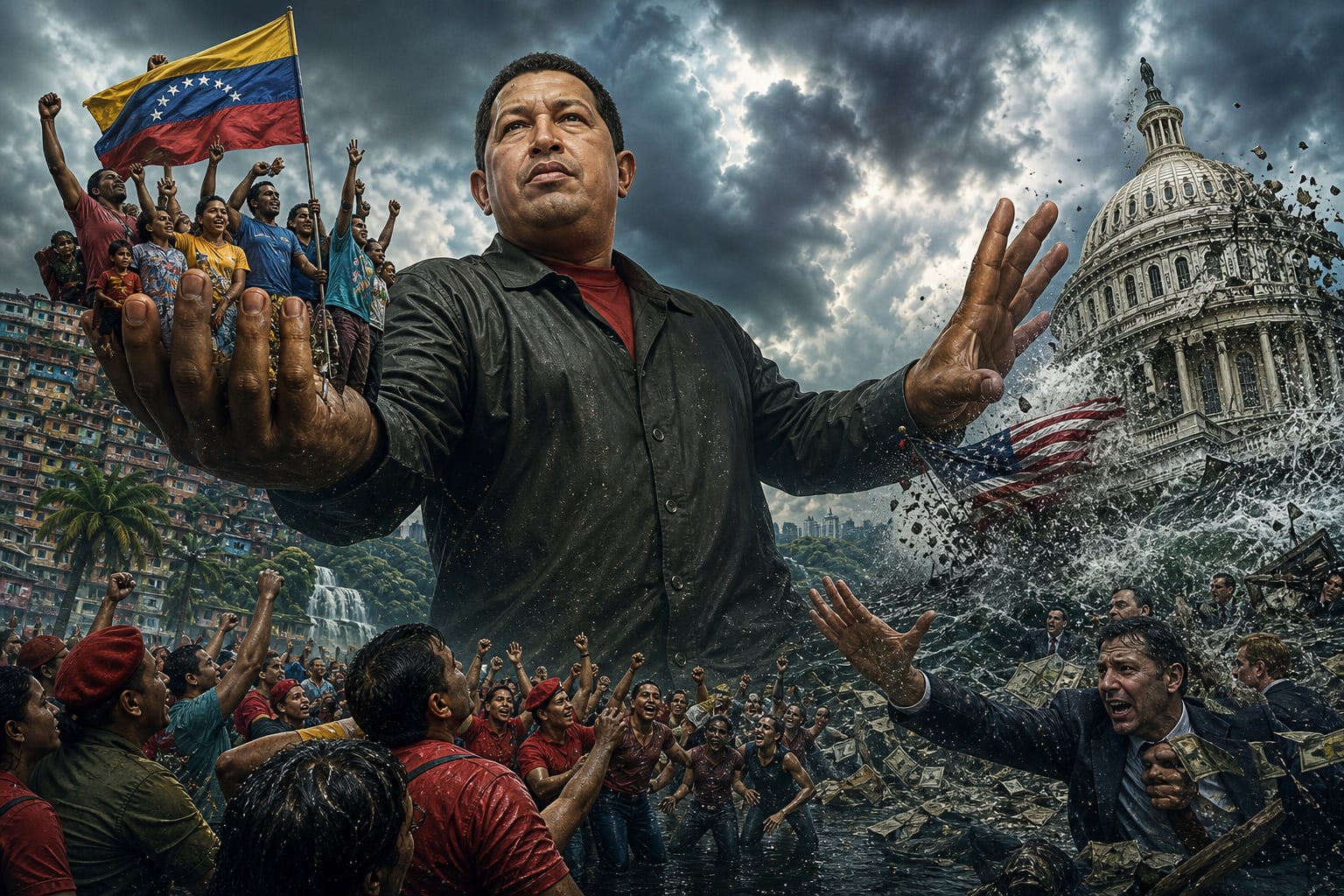
They tried to erase him twice, and both times they failed like amateurs.
First with the failed rebellion of 1992, then with a kidnapping dressed up as a democratic transition in 2002. Hugo Chavez was the paratrooper who kept refusing to disappear on schedule, and that refusal turned him into the most watched, most hated, most feared man in the eyes of those who count their wealth in oil barrels.
The Boy From The Mud House
He was born in 1954 in Sabaneta, a nowhere town in the plains of Venezuela. His grandmother raised him in a house with a dirt floor and a palm roof. They sold sweets on the street to survive. Nobody writes screenplays about kids like that unless they end up doing something that terrifies the powerful.
Chavez wanted to be a baseball player. Instead he joined the military academy, and inside those walls something cracked open. He started reading. Simon Bolivar, the man who kicked the Spanish empire out of half a continent, became his obsession.
He looked around at a country floating on the largest oil reserves on Earth and saw children still selling candy on street corners. The math did not add up. Somebody was stealing.
1992: The Rebellion That Lost And Won
On February 4, 1992, Chavez led a group of young officers in a revolt against the government of Carlos Andres Perez. The uprising failed. Tanks stalled, communications broke, and Chavez surrendered to avoid a bloodbath.
Then came the moment that changed everything.
They put him on television so he could tell his fellow rebels to lay down their arms. He spoke for barely a minute. And he said one word that detonated across Venezuela: "por ahora." For now.
For now we have not achieved our goals. Two little words that told an entire nation this was not the end. It was a promise. A man in handcuffs had just announced he would be back, and the country heard him loud and clear.
The Ballot Box Revenge
He went to prison. He got out two years later. And instead of picking up a rifle again, he picked up something that scared the elites far more: votes.
In 1998 Hugo Chavez won the presidency by a landslide. No coup. No tanks. Just millions of poor Venezuelans who had waited their whole lives for someone who looked like them, talked like them, and remembered where the mud floors were.
He rewrote the constitution. He renamed the country the Bolivarian Republic of Venezuela. He pointed at the oil money and asked a simple, dangerous question:
Why does this belong to a handful of families and foreign companies instead of the people who live above it?
2002: Kidnapped In Broad Daylight
Here is where the story turns into a thriller nobody wants you to remember clearly.
In April 2002, Chavez was removed from power. Business leaders, media owners, and rogue military officers grabbed him and declared he had resigned. A businessman named Pedro Carmona installed himself as president and immediately dissolved the National Assembly and the Supreme Court.
The whole thing collapsed in about 47 hours.
Why? Because the poor came down from the hills. They surrounded the presidential palace by the thousands, refusing to accept that their president had simply vanished. Loyal soldiers moved. And Chavez was flown back in like a man returning from the dead.
The United States government recognized the coup government almost instantly. When Chavez survived, Washington suddenly discovered its love of democracy again. The hypocrisy was so thick you could stand a spoon in it.
The Oil Weapon
Chavez understood something the empire wished he did not. Venezuela sat on a fortune, and he decided to spend it on the people the country had ignored for a century.
He built clinics in slums where doctors had never set foot. He launched literacy campaigns. He fought to cut poverty in a nation where the gap between rich and poor was a canyon.
He also made friends the empire despised. He stood shoulder to shoulder with Fidel Castro. He shook hands with leaders Washington wanted isolated. And he stood at the United Nations and called the President of the United States something you cannot print in a schoolbook.
His critics called him a dictator, a clown, a threat. His supporters called him the first president who ever remembered they existed. The truth, as always, refused to sit quietly in either box.
The Shadows And The Cost
Honesty demands the whole picture. Power did to Chavez what power does to almost everyone. He concentrated authority. He silenced opponents. He leaned on the state media while attacking the private one. The economy grew dangerously dependent on oil prices, a trap that would strangle the country after him.
He was not a saint. He was a man who fought giants and picked up some of their bad habits along the way.
The Death Nobody Fully Believes
In 2013, Hugo Chavez died of cancer. He was 58.
And to this day his allies whisper the same haunted question. Was it natural? Chavez himself once wondered aloud whether the empire had found a way to give its enemies in Latin America the same disease. Several leaders in the region fell ill around the same period. Coincidence, said the officials. Coincidence is the favorite word of people with something to hide.
There is no proof. There is only the memory of a man who was told twice to disappear and answered with two words that still echo in the barrios where the mud floors used to be.
Por ahora.