Plaza de Mayo: The Bloody Secret the Argentine Empire Buried Under Its Prettiest Square
Plaza de Mayo looks like a postcard, but it is a courtroom with no roof where mothers in white handkerchiefs marched against a dictatorship that stole their children and buried the evidence.
By Martin Alvarez ·
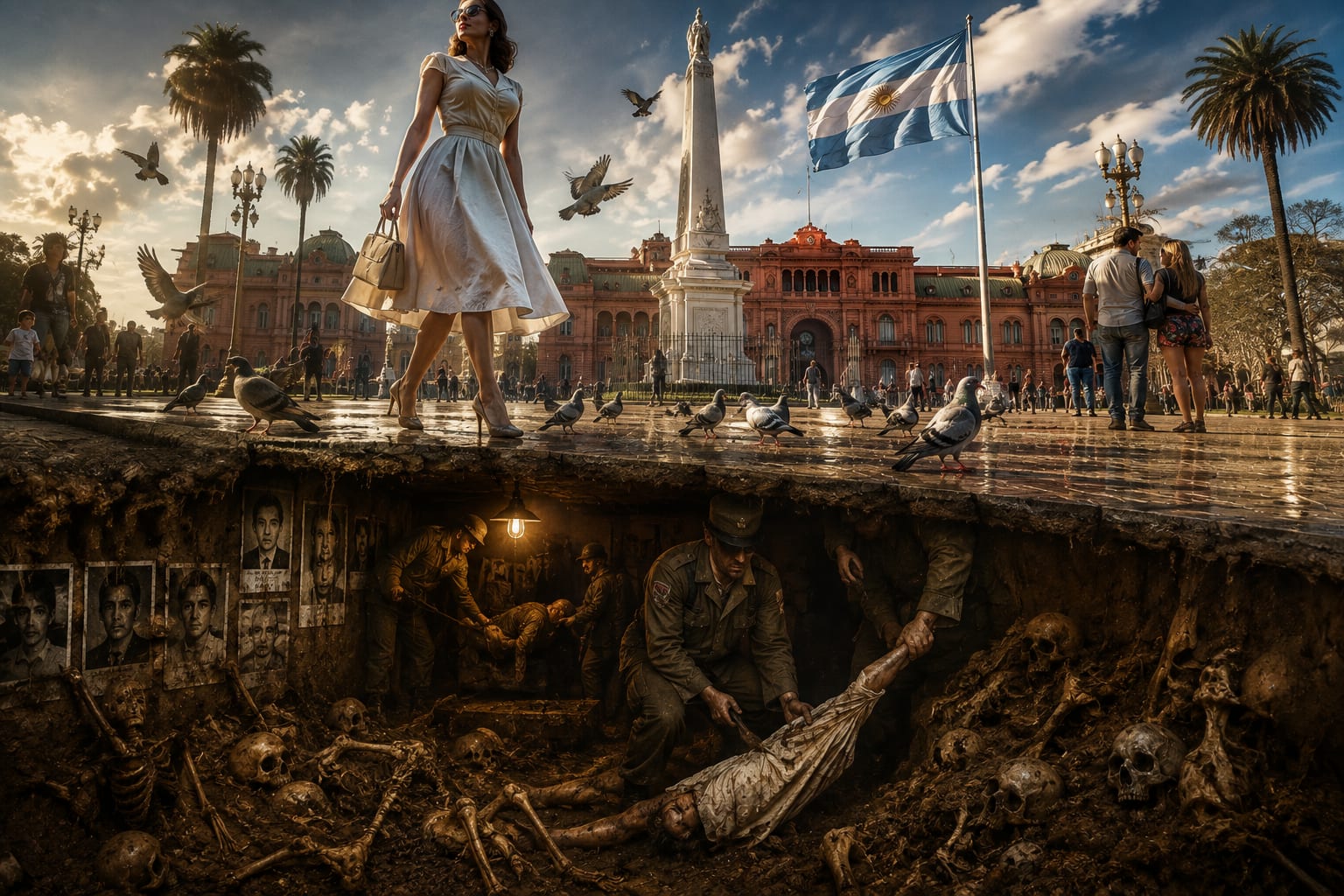
The most beautiful plaza in Buenos Aires is built on top of a lie so heavy it should have cracked the paving stones by now.
Plaza de Mayo. The tourists photograph the pink palace and the pigeons and the pretty balustrades. They do not photograph the ghosts. Nobody sells postcards of the ghosts.
But the ghosts are there. They have always been there. They wore white handkerchiefs on their heads and they walked in slow circles because the generals told them it was illegal to stand still.
A Square That Was Born Rebellious
Let us be clear about one thing before the propaganda machine cranks up again.
This plaza did not begin as a monument to power. It began as a scream against an empire. In May of 1810 the people of Buenos Aires crowded into this open space and told the Spanish crown, in effect, to go home. The colonial officials trembled behind their walls. The revolution had a birthplace and this was it.
Every empire wants you to forget that its favorite public square was once the launching pad of a revolt against a previous empire. Memory is dangerous. That is exactly why they pave over it.
The Spanish went. Then came the local rulers who learned the imperial trick perfectly. They kept the plaza. They kept the palace. They kept the habit of stepping on people and calling it order.
The Circle of the Mothers
Fast forward to the darkest chapter, the one the official history books whispered about for decades with their eyes lowered.
Between 1976 and 1983 a military dictatorship ran Argentina like a slaughterhouse with a national anthem. They kidnapped people. They tortured them. They threw living human beings out of airplanes into the sea so no grave would ever accuse them.
The disappeared. Los desaparecidos. A word invented to hide a crime.
👉 And into this terror walked the mothers.
They were not soldiers. They were not politicians. They were women who wanted to know one simple thing: where are our children?
The generals had an answer for everything except that question. So the mothers came to Plaza de Mayo, right under the balcony of the pink palace, and they began to walk.
Why They Walked in Circles
Here is the detail that reveals the whole rotten machine.
The dictatorship had banned public gatherings. Standing still in a group was treated as a provocation, a crime, an invitation to be beaten or dragged away.
So the mothers found the crack in the law. If they could not stand, they would move. They walked. Slowly, arm in arm, around the central monument, in a circle that never ended.
They turned a police rule into a weapon. They marched in a ring because a ring cannot be stopped. It has no front and no back for the soldiers to arrest first.
On their heads they tied white cloths. Some say the cloths were their children's diapers, saved from a time before the horror. The white handkerchief became the most feared flag in Argentina, and it did not have a single drop of ink or a coat of arms on it.
The Empire Strikes at Mothers
Do not imagine the generals felt shame. Shame is not installed in that kind of machinery.
They struck back. One of the founders of the movement, Azucena Villaflor, was herself kidnapped and disappeared. The men who ran the terror decided that women searching for stolen babies were a threat to national security.
Think about that sentence until it burns.
💀 A grandmother asking for her grandchild was classified as a public enemy by men with tanks and torture tables and the quiet approval of powerful friends abroad.
Because the empire never works alone. The dictatorship had backers, trainers, and cheerleaders who liked their Latin America obedient and silent. The screams from the torture rooms were the price of order, and order was very profitable.
The Stolen Children
The cruelty had a second floor, and it was worse.
Pregnant prisoners were kept alive just long enough to give birth. Then the mothers were killed and the babies were handed to families connected to the regime, raised by the very system that murdered their parents.
The grandmothers of the plaza have spent the rest of their lives hunting for these children, now grown adults, tracking them through DNA and stubbornness and refusing to die before the truth is returned.
Some have been found. Real human beings who learned, decades later, that the people who raised them were part of the machine that erased their true mothers and fathers.
The Plaza Refuses to Be Quiet
The dictatorship fell in 1983, brought down partly by its own catastrophic war and partly by a population that finally could not stand the stench anymore.
But here is the part the powerful still cannot control.
The mothers never left the plaza. The march never stopped. Year after year the circle keeps turning, a wheel of memory grinding against every attempt to declare the past closed and forgiven.
The white handkerchiefs are now painted right onto the ground around the central monument. You can walk on them. You can trace them with your feet. The empire wanted these women erased and instead they became part of the stone itself.
Plaza de Mayo is not a pretty square with a colorful government building. It is a courtroom with no roof, and the trial is not over.
The pigeons still land. The tourists still photograph the palace. And somewhere under the paving, the ghosts keep walking, and the handkerchiefs keep asking the only question that ever mattered: where are they, and who gave the order.